
As accounting firm grow, managing bookkeeping and financial operations becomes harder. Managing bookkeeping is critical, but it takes significant time and resources. Outsourcing accounting is a smart solution, helping firms grow without sacrificing quality.
This article explores how outsourcing accounting helps accounting firms scale efficiently. We’ll use examples, studies, and facts to support our points.
Why outsourcing accounting / bookkeeping is essential?
Bookkeeping involves accurate records, reporting finances, and managing compliance.
Many firms struggle with these tasks in-house. Limited resources or expertise can cause mistakes and inefficiencies.
Outsourcing helps solve these challenges effectively. Specialized providers handle bookkeeping. They offer knowledge, scalability, and cost efficiency.
Real-life example:
For example, in 2014, a tax firm struggled to maintain bookkeeping quality and wanted to focus more on tax compliance and advisory work.
They wanted to focus on tax compliance and advisory work.
By outsourcing, they cut bookkeeping processing times by 50%. This improved their bottom line.
Key benefits of outsourcing bookkeeping:
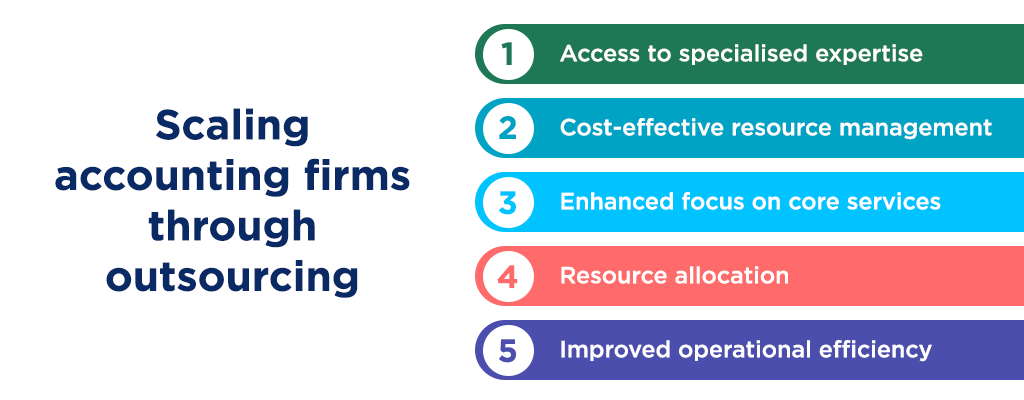
1. Save time for core activities
Outsourcing frees up time for core activities.
These include client acquisition, strategic planning, and advisory services.
This allows firms to focus on growth and high-value activities, rather than being bogged down by time-consuming tasks like data entry.
A Deloitte survey found that 40% of businesses see increased flexibility as a key benefit of outsourcing.
This helps firms prioritize high-value tasks.
2. Access to expertise
Outsourcing accounting provides skilled bookkeeping and accounting experts.
They stay updated on industry trends and regulations. This ensures compliance and accuracy.
A Clutch study found that 37% of small businesses outsourced accounting services in 2019.
This trend has grown as firms see the value of external expertise.
3. Cost efficiency
Cost savings are a major reason to outsource.
Keeping an in-house team involves salaries, benefits, and training costs.
Outsourcing removes these costs.
- According to a Deloitte survey, 70% of businesses outsource primarily for cost savings, such as reducing expenses on salaries, office space, and training.
- Firms can save up to 50% on operational costs by outsourcing bookkeeping.
4. Improved financial reporting
Outsourced payroll / bookkeepers provide detailed reports.
These offer insights into business performance.
Reports include:
- Cash flow statements.
- Profit-and-loss summaries.
- Balance sheets.
These are easily accessible.
Benefits include:
- Enhanced visibility into cash flow trends.
- Simplified sharing of financial data.
- Quantitative insights for decision-making.
5. Stress-free tax preparation
Tax season can be stressful.
Accurate documentation and compliance are essential.
Outsourced bookkeepers keep records organized year-round.
This ensures a smooth tax filing process.
This helps to:
- Avoid last-minute scrambling for records.
- Ensure compliance with tax regulations.
- Identify potential deductions to minimize liabilities.
6. Scalability
Bookkeeping needs grow as firms grow.
Outsourcing remote accounting offers the flexibility to scale services up or down.
Whether handling seasonal spikes or expanding into new markets, outsourced providers adapt quickly.
According to industry reports, the global market for finance and accounting outsourcing is projected to grow 11-13% annually, reflecting the increasing demand for these services.
This shows how much businesses rely on scalable solutions.
7. Enhanced data security
Data security is crucial.
Reputable providers invest heavily in cybersecurity.
They protect client data from breaches or theft with:
- Advanced encryption technologies.
- Regular audits and compliance checks.
- Secure cloud-based storage solutions.
8. Better decision-making
Accurate data allows for better decisions.
It provides insights into profitability, cash flow, and cost management.
Outsourced bookkeepers offer detailed analyses.
They help firms identify opportunities and areas for improvement, like:
- Determining which services generate the most revenue.
- Identifying unprofitable clients or projects.
- Allocating resources more effectively.
Key Studies:
- Clutch Survey (2019): 37% of small businesses outsourced accounting for cost savings and expertise.
- Deloitte Survey (2020): 70% of businesses cited cost reduction as the main reason for outsourcing.
- Global Market Trends: The finance and accounting outsourcing market is projected to grow 11–13% annually.
How outsourcing supports growth
Outsourcing isn’t just about saving money. It’s a strategic move that supports growth. It allows firms to focus on high-value activities using external expertise.
Steps to get started:
- Assess Your Needs: Identify tasks to outsource.
- Research Providers: Find reputable firms with industry experience.
- Set Clear Expectations: Define goals and communicate them clearly.
- Monitor Performance: Review reports and feedback regularly.
These steps help maximize outsourcing benefits.
Conclusion
Outsourcing bookkeeping offers significant advantages for UK accounting firms looking to scale without compromising service quality.
From cost savings and access to experienced professionals to improved reporting and risk management, outsourcing streamlines operations while supporting growth in the UK market. Studies show that many UK SMEs and small practices are increasingly adopting outsourced bookkeeping to stay competitive.
itender Patel, a well-known consultant in the accounting industry, emphasizes that selecting the right outsourcing partner is crucial for success. For UK firms, choosing a provider familiar with UK accounting standards, HMRC compliance, VAT, payroll, and Companies House reporting ensures accurate, reliable results. By strategically outsourcing, accounting firms can deliver exceptional value to clients and achieve long-term sustainable growth in a competitive market.
Next steps for UK firms:
- Evaluate Your Firm’s Needs: Identify time-consuming bookkeeping tasks, such as VAT returns, payroll, and statutory filings, and assess which tasks could be outsourced.
- Research Outsourcing Providers: Look for providers with expertise in UK accounting requirements.
- Schedule Consultations: Discuss your firm’s specific needs and regulatory considerations with potential partners.
By following these steps, UK accounting firms can leverage outsourcing effectively, improving efficiency, accuracy, and client satisfaction.
FAQs
Can outsourcing accounting services reduce errors as a firm scales?
Yes. Outsourcing accounting services often reduces errors because specialist providers use standardised processes, quality checks, and experienced teams. This ensures consistent accuracy even as client volume increases.
What accounting tasks should firms outsource first when scaling?
Accounting firms usually outsource high-volume, process-driven tasks first, such as:
- Bookkeeping and data entry
- VAT returns and reconciliations
- Payroll processing
- Bank reconciliations
- Year-end accounts preparation support
This allows internal teams to focus on advisory and client relationships.
How does outsourcing help maintain service quality for clients?
Outsourcing helps maintain quality by providing:
- Dedicated specialists for specific accounting functions
- Documented workflows and review systems
- Faster turnaround times
- Reduced workload pressure on in-house staff
This leads to more consistent and reliable client service.
Is outsourcing suitable for small and mid-sized accounting firms?
Yes. Outsourcing is especially valuable for small and mid-sized accounting firms that want to grow without hiring full-time staff. It offers flexible capacity, predictable costs, and access to skilled professionals without long-term employment commitments.
How does outsourcing support advisory-led growth for accounting firms?
By outsourcing bookkeeping and compliance tasks, firms free up time to focus on advisory services, such as:
- Tax planning
- Cash flow forecasting
- Business performance reviews
- Strategic financial advice
This improves profitability and strengthens client relationships.
Will outsourcing affect client confidentiality?
No, if you work with a reputable provider. Professional outsourcing partners follow strict data protection policies, secure cloud systems, NDAs, and compliance standards to ensure client confidentiality and data security.
Can outsourced teams work with UK accounting software?
Yes. Most outsourced accounting providers support popular UK software, including:
- Xero
- QuickBooks
- Sage
- FreeAgent
This ensures seamless collaboration and real-time financial visibility.
How quickly can outsourcing help an accounting firm scale?
Outsourcing allows firms to scale almost immediately. Instead of waiting months to recruit and train staff, firms can increase capacity within days or weeks, making it ideal for handling seasonal demand or rapid growth.
What should UK accounting firms look for in an outsourcing partner?
UK firms should choose providers who understand:
- HMRC regulations
- VAT and MTD compliance
- Payroll legislation
- Companies House filing requirements
Industry experience and UK compliance knowledge are essential for long-term success.
Does outsourcing reduce control over accounting processes?
No. Outsourcing gives firms more control, not less. Clear workflows, reporting, and regular reviews allow firms to oversee work quality while eliminating operational bottlenecks.
Ready to Scale Your Accounting Firm?
Outsource your bookkeeping and save time for more important tasks. Start now!
Get Started
Parul is a content specialist with expertise in accounting and bookkeeping. Her writing covers a wide range of accounting topics such as payroll, financial reporting and more. Her content is well-researched and she has a strong understanding of accounting terms and industry-specific terminologies. As a subject matter expert, she simplifies complex concepts into clear, practical insights, helping businesses with accurate tips and solutions to make informed decisions.