
For UK small and medium-sized businesses, correctly identifying allowable business expenses is one of the most consequential tasks in financial management. HMRC business expenses rules set clear boundaries around what qualifies for tax relief, yet many SMEs, limited company directors and self-employed professionals either under-claim through lack of awareness or over-claim through misinterpretation. Both errors carry risk.
When business expenses are misclassified, the consequences extend beyond a rejected claim. Overstated deductions may attract HMRC scrutiny or penalties. Under-claimed expenses result in a higher Corporation Tax or Income Tax liability than is legally required, a direct cost to the business with a material effect on cash flow and audit readiness.
Key takeaways
- A structured, HMRC-explained breakdown of allowable business expenses
- Clear distinction between revenue cost and capital allowances
- Differences between allowable expenses for limited companies and self-employed individuals
- Practical compliance and record-keeping guidance for UK SMEs
- The 2026/27 mileage rate increase to 55p per mile for the first 10,000 business miles in a car or van backdated to 6 April 2026
What are Allowable Business Expenses under HMRC rules?
Under HMRC business expenses rules, a cost qualifies as an allowable expense if it is incurred wholly and exclusively for business purposes. This principle applies to both limited companies and self-employed individuals.
Business expenses refer to day-to-day operational cost necessary to run the business. When a cost meets HMRC criteria, it becomes tax deductible, meaning it can be deducted from taxable profits before calculating tax liability.
Where an expense has both a business and private element, the business portion may be claimed if it can be clearly identified and apportioned on a reasonable basis. For limited companies, HMRC applies the rule more strictly under section 54 CTA 2009 a measurable basis for the split is usually required and dual-purpose cost that cannot be split are disallowed in full. This distinction forms the foundation of HMRC compliance.
Complete HMRC List of Allowable Business Expenses for SMEs
The categories below reflect HMRC allowable expenses commonly claimed by UK SMEs.
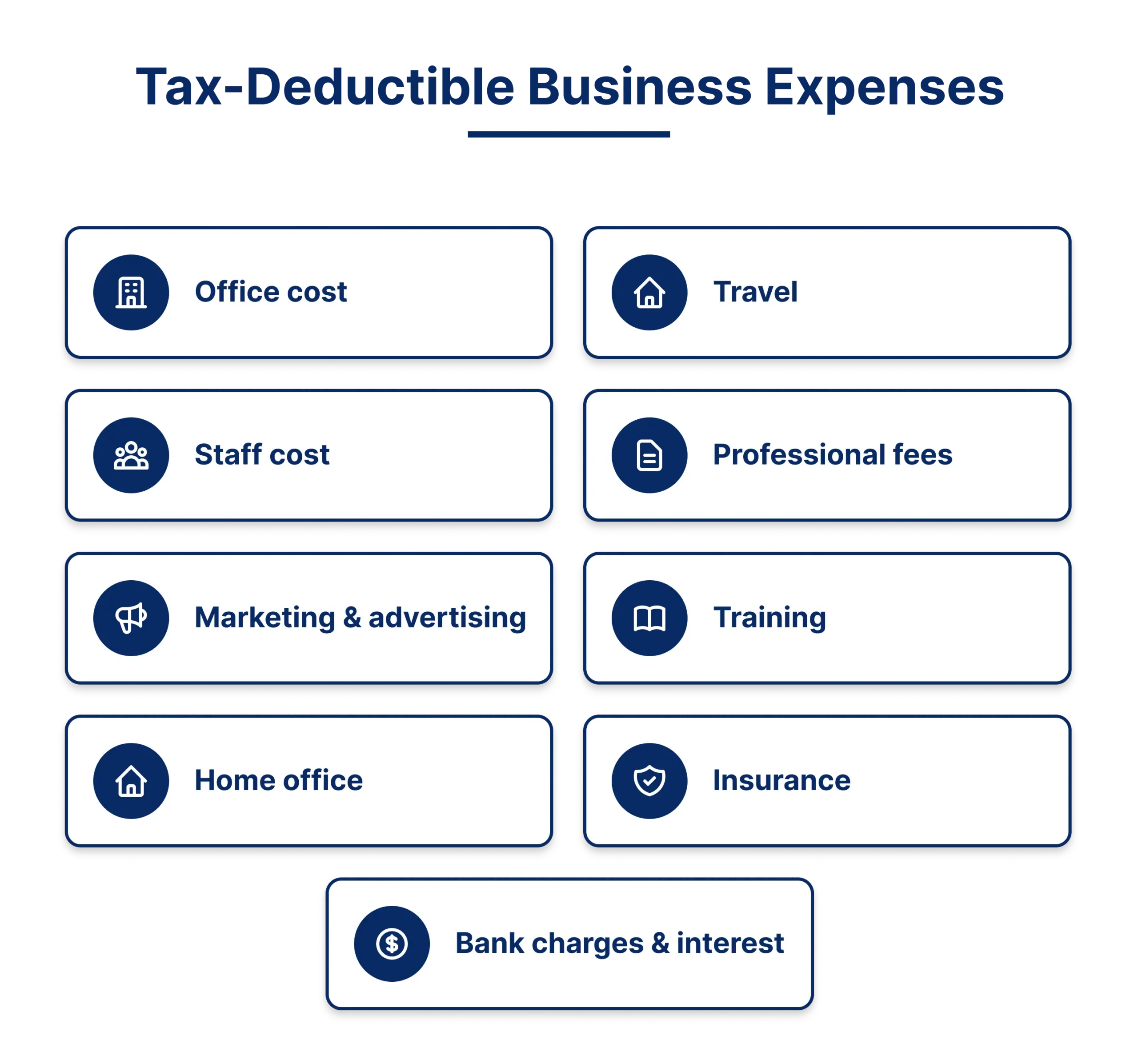
Office cost
- Rent for business premises
- Business rates and utilities
- Office supplies such as stationery
- Software subscriptions used for operations
- Telephone and broadband (business proportion only)
Travel expenses
- Mileage for business journeys, see the updated approved rates below
- Train, bus and air fares for work travel
- Hotel accommodation for business trips
- Parking fees and tolls
- Subsistence on qualifying business journeys (reasonable meals away from a permanent workplace)
Approved Mileage Allowance Payments (AMAPs) – 2026/27 rates
On 21 May 2026, the Chancellor announced an increase to the Approved Mileage Allowance Payment the first change in 15 years. The new rates, backdated to 6 April 2026, are:
- Cars and vans: 55p per mile for the first 10,000 business miles (up from 45p)
- Cars and vans: 25p per mile thereafter (unchanged)
- Motorcycles: 24p per mile (unchanged)
- Bicycles: 20p per mile (unchanged)
- Carrying a fellow employee on the same business journey: 5p per passenger per mile (unchanged)
These rates apply to both employees (including limited company directors) reimbursed by their employer and to self-employed individuals using the simplified expenses method. Employers reimbursing at the old 45p rate from 6 April 2026 may make a tax-free top-up payment to align with the new approved amount. The full HMRC schedule is published on GOV.UK – travel mileage and fuel allowances.
Ordinary commuting between home and a permanent workplace is not tax deductible. An exception applies to travel to a temporary workplace defined by HMRC as a site attended for a period not expected to exceed 24 months. The same applies to mobile workers and CIS subcontractors who do not have a single permanent base.
Staff cost
- Salaries and wages
- Employer National Insurance contributions
- Pension contributions
- Bonuses and commissions
- Staff welfare facilities
- Subcontractor payments (with correct CIS or employment status checks)
- Training courses for existing staff that relate to their current role
Staff entertainment: The £150 Annual Party Exemption
HMRC permits up to £150 per head per tax year (inclusive of VAT) on annual social events such as a Christmas or summer party. Where total spend per head stays within this limit, the cost is allowable for the business and exempt from Income Tax and National Insurance for employees. Two conditions apply:
- The event must be annual and open to all employees
- The £150 is an exemption, not an allowance exceeding it by even £1 makes the entire cost taxable as a benefit in kind, not just the excess
Professional fees
- Accountancy fees
- Legal fees relating to business matters
- Consultancy services
- Industry membership subscriptions (only where the body appears on HMRC’s approved list 3)
Marketing and advertising
- Website hosting and maintenance
- Online advertising
- Printed promotional materials
- Trade directory listings
Client entertainment is generally not allowable. This covers restaurant meals, hospitality at sporting or cultural events and gifts to clients that include food, drink, tobacco or a business advertisement worth more than £50 per recipient per tax year.
Training expenses
- Work-related training to maintain or improve existing skills
- Mandatory compliance courses
- Continuing professional development (CPD) required to retain a professional qualification
Training that introduces a new trade or qualification is usually disallowed.
Home office expenses: 2025/26 and 2026/27 rates
For self-employed individuals using HMRC’s simplified expenses method, the flat-rate amounts are:
- £10 per month – 25 to 50 hours of home working
- £18 per month – 51 to 100 hours
- £26 per month – 101 or more hours
For limited company directors and employees, HMRC allows a flat rate of £6 per week (£312 per year) without receipts. This is the only flat-rate method available to limited companies, they cannot use the self-employed simplified rates.
Where actual cost are claimed instead, a reasonable apportionment of household bills is required, commonly by rooms used for business multiplied by the proportion of time of business use. Only the additional cost caused by business use can be claimed. A formal rental agreement between a director and their company creates rental income on the director’s Self-Assessment return and should be used with care.
Insurance
- Professional indemnity insurance
- Public liability insurance
- Employers’ liability insurance
- Business vehicle insurance
Bank charges and interest
- Business bank account fees
- Interest on business loans or overdrafts
- Credit card processing charges
Summary of Key Allowable Expense Categories
| Category | Examples | Tax Deductible? |
|---|---|---|
| Office cost | Rent, utilities, supplies | Yes |
| Travel expenses | Business mileage at 55p/25p (cars/vans), train, hotel | Yes (excluding ordinary commuting) |
| Staff cost | Wages, employer NI, pensions, subcontractors | Yes |
| Staff entertainment | Annual events within £150/head | Yes (within exemption) |
| Marketing | Advertising, website hosting | Yes |
| Training expenses | Skill maintenance, mandatory CPD | Yes (if relevant to existing role) |
| Home office | £6/week (Ltd) or £10–£26/month (self-employed) | Yes |
| Insurance | Professional indemnity, public liability | Yes |
| Bank charges | Loan interest, account fees | Yes |
Non-Allowable Business Expenses under HMRC rules
Not every business cost qualifies for tax relief. HM Revenue and Customs also defines non-allowable business expenses, which cannot be deducted from profits.
These usually arise when a cost is personal, capital in nature or not incurred solely for business purposes.
Client entertainment
Expenses related to entertaining clients are generally not tax deductible.
Examples include:
- Restaurant meals with clients
- Event or hospitality tickets
- Sporting event entertainment
Personal expenses
Cost with a private element cannot be claimed unless the business portion is clearly separated.
Examples include:
- Personal travel
- Everyday clothing (uniforms, protective clothing and costumes for performers remain allowable)
- Household purchases
Fines and penalties
Penalties are not considered legitimate business cost.
Examples include:
- Late filing penalties
- Parking fines
- Regulatory fines
Capital purchases claimed incorrectly
Long-term assets cannot be deducted as normal expenses.
Examples include:
- Business vehicles
- Machinery and equipment
- Computers and office furniture
These fall under capital allowances instead.
Summary of Non-Allowable Expenses
| Category | Examples | Tax Deductible |
|---|---|---|
| Client entertainment | Meals, hospitality events | No |
| Personal expenses | Private travel, everyday clothing | No |
| Fines and penalties | Parking fines, late penalties | No |
| Capital purchases | Vehicles, machinery | No (capital allowances apply) |
Allowable Expenses for Limited Company vs Self-Employed
The core rules are similar, but tax treatment differs in structure.
| Area | Allowable Expenses for Limited Company | Allowable Expenses for Self-Employed |
|---|---|---|
| Tax system | Deducted before Corporation Tax (19% small profits rate up to £50,000; 25% main rate above £250,000; marginal relief between) | Deducted before Income Tax and Class 4 NI |
| Director salary | Treated as staff cost | Not applicable |
| Dividends | Not an expense | Not applicable |
| Personal drawings | Not allowable | Not allowable |
| Pension contributions | Employer contributions deductible | Personal pension relief rules apply |
| Capital allowances | Claimed by company (AIA £1m, plus full expensing on main-rate plant) | Claimed by individual (AIA £1m) |
| Working from home | £6/week flat rate (£312/year) or apportioned actual cost | Simplified rates of £10, £18 or £26 per month or actual cost apportionment |
| VAT | Registration threshold £90,000 (from 1 April 2024); input VAT recoverable on most business cost | Same threshold applies in personal capacity |
Allowable expenses for limited companies must be incurred by the company, not personally by directors unless properly reimbursed and supported by receipts.
Allowable expenses for self-employed individuals must meet the wholly and exclusively rule and be declared within Self-Assessment.
Capital Allowances vs Revenue Expenses
A key distinction within business expenses is between revenue cost and capital allowances.
Revenue expenses are day-to-day running cost such as rent, utilities and travel expenses. These are deducted directly from profits in the accounting period incurred.
Capital allowances apply to longer-term assets such as:
- Office equipment
- Machinery
- Business vehicles
- IT hardware
Instead of deducting the full cost as a revenue expense, tax relief is given through capital allowances.
The Annual Investment Allowance (AIA) is set at £1 million per year, made permanent from 1 April 2023. It is available to sole traders, partnerships and limited companies and gives 100% first-year relief on qualifying plant and machinery up to the £1 million limit.
Full expensing, made permanent in the Autumn Statement 2023, is available only to companies subject to Corporation Tax. It gives 100% first-year relief on qualifying main-rate plant and machinery with no upper limit and 50% first-year relief on qualifying special-rate items. Most main-rate company purchases laptops, office equipment, machinery can be claimed in full in the year of purchase under this regime.
For example, purchasing a laptop for daily operations falls under capital allowances rather than standard business expenses and is typically fully relieved in the year of purchase under either the AIA (sole traders, partnerships and companies) or full expensing (companies only).
Understanding this distinction prevents incorrect deductions and supports accurate HMRC compliance.
HMRC Compliance and Record Keeping
HMRC compliance requires clear evidence supporting each expense claim. HMRC guidance confirms that businesses must retain:
- Invoices and receipts
- Bank statements
- Mileage logs for travel expenses
- Home office calculation records
- Payroll documentation
- VAT records, where applicable
Digital record-keeping is increasingly expected, particularly under Making Tax Digital requirements. From April 2026, MTD for Income Tax begins to apply to self-employed individuals and landlords with qualifying income over £50,000, with the £30,000 threshold following from April 2027 and the £20,000 threshold from April 2028.
Compliance Checklist
Incomplete documentation increases risk during an enquiry.
Can you claim these Business Expenses?
Some expenses can be easily claimed while others can’t. The table below gives better clarity for this:
| Expense | Can You Claim It? | Conditions |
|---|---|---|
| Working lunch with a client | No | Treated as client entertainment, fully disallowed |
| Working lunch with staff (annual party) | Yes | Within the £150 per head exemption |
| Working lunch with staff (regular) | No | Treated as a benefit in kind |
| Christmas gifts to staff (cash or near-cash) | No | Treated as earnings and subject to PAYE |
| Christmas gifts to staff (trivial benefits under £50) | Yes | Must meet the four trivial benefit conditions |
| Christmas gifts to clients | Limited | Only if branded, not food/drink/tobacco, and under £50 per recipient per year |
| Mobile phone in company name | Yes | One phone per employee, no benefit in kind |
| Mobile phone in employee’s name | Business proportion only | Personal element must be excluded |
| Working from home (employee) | Yes | £6 per week flat rate or apportioned actual cost |
| Working from home (sole trader) | Yes | £10, £18 or £26 per month flat rate, or apportioned actual cost |
| Eye tests for screen users | Yes | Required under Health and Safety regulations |
| Glasses or contact lenses | Limited | Only the portion specifically for screen use |
| Childcare vouchers (closed schemes) | Yes | Existing members of pre-October 2018 schemes only |
| Tax-Free Childcare top-ups | No | Paid by government, not the employer |
| Cycle to Work scheme | Yes | Through a registered salary sacrifice arrangement |
| Personal pension contributions (sole trader) | No | Claimed personally on Self Assessment, not as a business expense |
| Employer pension contributions (limited company) | Yes | Wholly and exclusively for business purposes |
| Suit or office wear | No | Dual purpose, treated as everyday clothing |
| Branded uniform | Yes | Must carry a visible permanent logo |
| Protective clothing or safety boots | Yes | Required for the work being performed |
| Gym membership | No | Personal benefit, treated as a benefit in kind |
| Health insurance | Limited | Treated as a benefit in kind unless wholly for medical screening |
| Charitable donations from a limited company | Yes | To registered UK charities only |
| Charitable donations from a sole trader | No | Claimed through Gift Aid personally, not on the business |
| Speeding fines incurred during work | No | All fines and penalties are disallowed |
| Parking fines | No | Disallowed even if incurred on business |
| Parking fees (legitimate) | Yes | Allowable as travel expense |
Why Accurate Expense Recording is important for SMEs?
Accurate recording of business expenses ensures maximum legitimate tax relief while reducing exposure to penalties. Proper classification supports:
- Reliable profit reporting
- Improved cash flow forecasting
- Strong audit readiness
- Reduced HMRC compliance risk
Well-maintained records also support collaboration with bookkeeping services, provide clarity for bookkeeping support teams and strengthen oversight when using outsourcing accounting arrangements.
Consistent processes protect both tax efficiency and operational control.
Conclusion
Understanding allowable business expenses under UK tax law is essential for SMEs seeking clarity and compliance. This guide has provided a complete HMRC-explained breakdown of eligible categories, distinctions between allowable expenses for limited companies and self-employed individuals and the critical difference between revenue cost and capital allowances.
By applying HMRC business expenses rules carefully, maintaining structured records and ensuring accurate classification, businesses can secure legitimate tax relief while minimising compliance risk. Recent changes particularly the rise in the AMAP rate from 45p to 55p per mile, backdated to 6 April 2026 also make it worth reviewing how mileage and travel expenses are reimbursed during the current tax year.
Professional bookkeeping support can help ensure expenses are recorded accurately and remain fully compliant.
Frequently Asked Questions
1. What qualifies as tax deductible business expenses in the UK?
Expenses must be wholly and exclusively for business purposes under HMRC business expenses rules.
2. Can commuting cost be claimed?
No. Ordinary commuting between home and a permanent workplace is not allowable. An exception applies to travel to a temporary workplace not expected to last more than 24 months and to mobile workers or CIS subcontractors without a single permanent base.
3. Are home office expenses allowed?
Yes. Self-employed individuals can claim £10, £18 or £26 per month based on hours worked from home or apportion actual cost. Limited company directors can claim £6 per week (£312 per year) or use apportioned actual cost.
4. Is client entertainment tax deductible?
Generally no, client entertainment is not an allowable expense. Staff entertainment, however, benefits from a separate exemption of up to £150 per head per tax year on annual events open to all employees.
5. Are training expenses always allowable?
Only if the training maintains or improves existing business skills. Training that introduces a new trade or qualification is usually disallowed.
6. What is the difference between revenue cost and capital allowances?
Revenue cost are daily operational expenses deducted directly from profits. Capital allowances apply to long-term assets and are claimed through the Annual Investment Allowance (£1 million per year) or, for companies, full expensing on qualifying main-rate plant and machinery.
7. Do limited companies and sole traders follow different rules?
The core principles are similar, but tax systems differ. Limited companies pay Corporation Tax (19% on profits up to £50,000, 25% above £250,000, with marginal relief in between.
8. How long must expense records be kept?
Typically at least six years for UK tax purposes. Limited companies must keep records for six years from the end of the accounting period. Sole traders must keep records for five years from the 31 January Self-Assessment submission deadline.
9. What are the HMRC approved mileage rates from 6 April 2026?
Cars and vans: 55p per mile for the first 10,000 business miles, then 25p per mile. Motorcycles: 24p per mile. Bicycles: 20p per mile. An additional 5p per mile applies for each fellow employee carried on the same business journey. These rates were announced on 21 May 2026 and backdated to 6 April 2026 the first AMAP increase in 15 years.
10. What is the VAT registration threshold?
£90,000 of rolling 12-month taxable turnover, in force since 1 April 2024. The deregistration threshold is £88,000. VAT-registered businesses can generally reclaim input VAT on allowable business expenses, subject to specific rules for entertaining and motoring.

Parul is a content specialist with expertise in accounting and bookkeeping. Her writing covers a wide range of accounting topics such as payroll, financial reporting and more. Her content is well-researched and she has a strong understanding of accounting terms and industry-specific terminologies. As a subject matter expert, she simplifies complex concepts into clear, practical insights, helping businesses with accurate tips and solutions to make informed decisions.