

HMRC has increased its focus on personal expenses incorrectly claimed as business deductions during the 2025/26 Self Assessment cycle.
Sole traders, landlords and self-employed individuals are now receiving more digital prompts, warning emails and automated compliance checks were mixed personal and business expenses appear unusually high.
While these alerts do not automatically mean a formal investigation, HMRC’s enhanced compliance systems are placing greater scrutiny on expense claims, especially home office, travel, vehicle and mixed-use costs.
Understanding the latest HMRC expense rules can help reduce compliance risk, avoid penalties and improve record-keeping accuracy now that Making Tax Digital (MTD) for Income Tax is in effect from 6 April 2026.
What Has Changed in HMRC Expense Monitoring
HMRC’s personal expense monitoring programme, introduced during the 2025 Self-Assessment cycle, continues into 2026 with broader digital prompts, stronger analytics and behavioural nudges across filing journeys. Key developments include:
- Expansion of digital prompts during Self-Assessment completion
- Comparative analytics across similar industries and taxpayer profiles
- Integration with Making Tax Digital record-keeping expectations
- Greater use of behavioural messaging instead of immediate enquiries
- Mandatory evidence requirements for PAYE (P87) employment expense claims from 14 October 2024, with HMRC checking every claim before approving relief
Quick Takeaways:
- HMRC is actively checking personal vs business expenses
- Automated systems flag claims over £2,500
- Emails and digital warnings are part of the campaign
- Sole traders and landlords face higher scrutiny
- Correct apportionment and records reduce penalties
- Home office, vehicle and travel costs attract the most HMRC scrutiny, according to compliance focus areas identified during the 2024 trial
What Is the £2,500 Expense Flag?
The £2,500 figure applies in two HMRC contexts and they are often confused:
- Self Assessment expense claims: where total business expense claims exceed £2,500 in a tax year, HMRC’s automated systems apply additional digital scrutiny to the return. This does not mean automatic investigation, but it does trigger a risk assessment of the expense breakdown.
- PAYE employment expense claims: employees can claim tax relief on work expenses through PAYE up to £2,500 per tax year using form P87 or the online iForm. Above £2,500, a Self Assessment return is required to claim. From 14 October 2024, every PAYE expense claim must be supported by evidence (receipts, mileage records) before HMRC approves relief.
If your business expense claims approach £2,500, ensure every expense is supported by receipts, invoices or digital records, that any mixed-use apportionment is clearly documented and that no personal element has been included, even unintentionally.
I Received an HMRC Expenses Email. Should I Be Worried?
Most HMRC expenses emails in 2026 are educational warnings, not formal investigations. HMRC uses these messages to remind taxpayers about the wholly and exclusively rule before returns are submitted.
However, you should take the email seriously if:
- Your expenses exceed £2,500
- You claim home office, vehicle or travel costs
- You mix personal and business use
If errors exist, correcting them before submission or via voluntary disclosure significantly reduces penalties.
What Is HMRC’s Personal Expense Claims Campaign?
HMRC’s 2025 to 2026 digital campaign uses automated prompts, emails and online warnings to prevent taxpayers from claiming personal expenditure as business expenses.
Many taxpayers see this as:
- An HMRC expenses email
- A digital advert or message during Self-Assessment
- A warning asking if expenses exceed £2,500 in a tax year
The campaign applies to 2024/25 and 2025/26 Self-Assessment returns and forms part of HMRC’s wider compliance and Making Tax Digital strategy.
HMRC personal expense campaign
HMRC’s personal expense campaign is a digital compliance initiative using automated prompts, analytics and behavioural messaging to reduce incorrect mixed-use expense claims within Self-Assessment submissions.
HMRC Digital Campaign 2025 to 2026
HMRC has shared a document with ICAEW which explains that the digital campaign follows a trial in 2024. The trial results prompted this expanded enforcement programme. Self-Assessment tax return 2025 HMRC submissions face increased automated checks.
HMRC’s 2025 expense compliance checks use advanced analytics software. The system identifies patterns suggesting inappropriate expense claims. HMRC uses automated analytics and digital risk assessment systems to compare expense patterns across similar taxpayer profiles. Source: ICAEW, August 2025
Digital validation occurs during the submission process now. Previously flagged issues trigger immediate warnings or enquiries. This proactive approach prevents incorrect claims reaching completion.
This initiative aligns with broader UK compliance developments including Making Tax Digital for Income Tax, HMRC behavioural insights programmes and increasing reliance on digital bookkeeping platforms such as Xero, QuickBooks and FreeAgent for evidence readiness.
HMRC Personal Expenses and Business Expenses Tax UK: Target Reason
HMRC discovered significant problems with ‘disallowable private use in business expenditure’ during their initial trial. The substantial revenue generated from correcting these errors has prompted this focused approach. The HMRC expense review process initiative represents their most comprehensive compliance effort yet.
HMRC will now open more enquiries specifically targeting taxpayers who claim personal expenses as business deductions. This initiative follows successful identification of widespread non-compliance in expense apportionment.
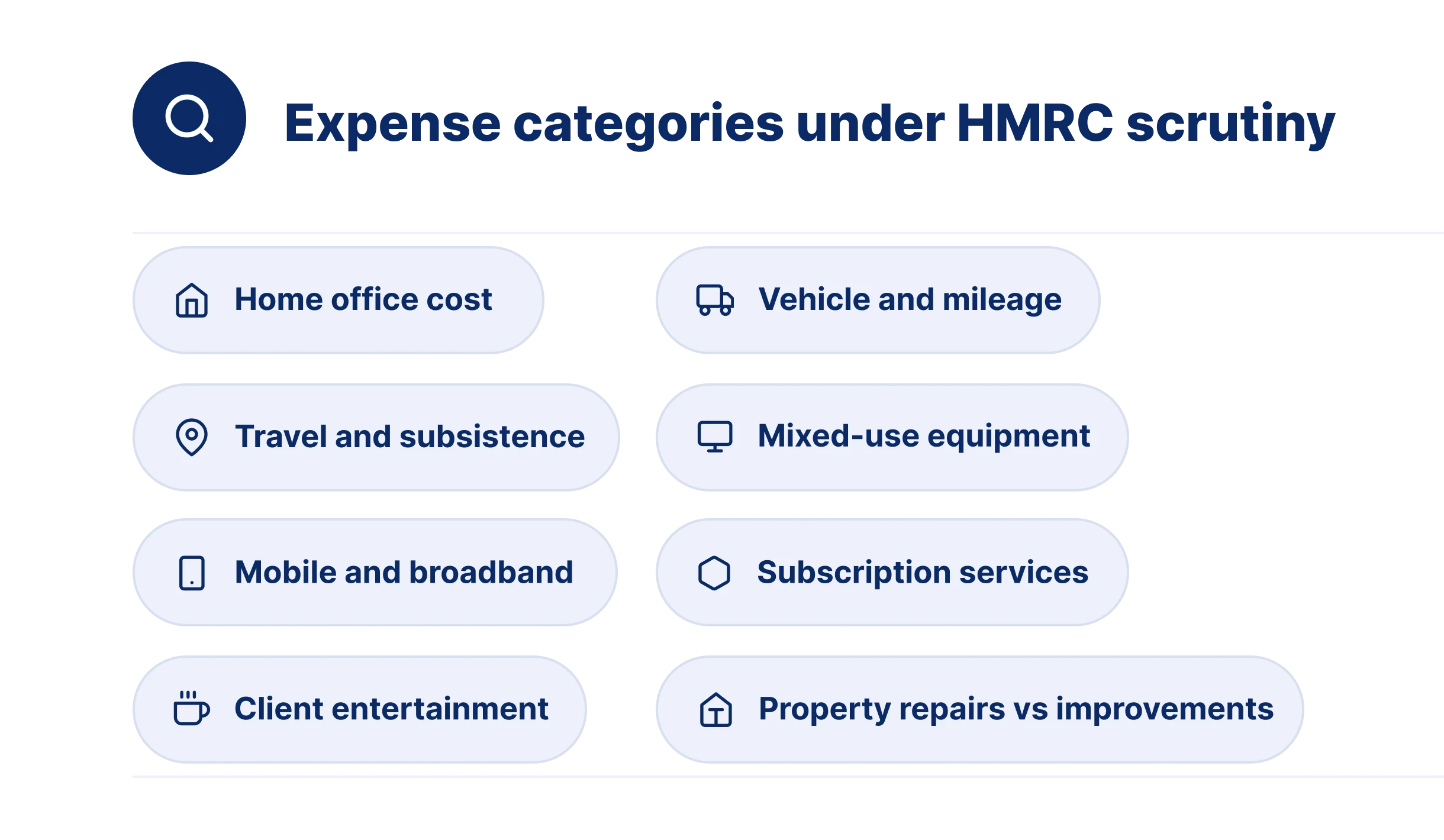
Which expense categories attract the most HMRC scrutiny? The table below shows the four categories where HMRC’s compliance focus is highest, based on the trial findings and current campaign focus.
| Expense Category | Common Issues | HMRC Focus Level |
|---|---|---|
| Home Office | Excessive utility apportionment | High |
| Vehicle Costs | Personal mileage included | High |
| Equipment | Mixed personal/business use | Medium |
| Travel Expenses | Holiday elements claimed | High |
Understanding the Wholly and Exclusively Rule
The fundamental principle governing business expense claims requires expenses to be incurred ‘wholly and exclusively for trade purposes.’ This rule forms the cornerstone of legitimate business expense claims. Understanding this principle is important for avoiding HMRC penalties. The rule allows partial claims where specific business portions can be identified and properly documented.
Sole trader expense apportionment HMRC requirements demand accurate calculation and supporting evidence. Mixed-use expenses require careful analysis to separate business and personal elements.
3-step compliance framework
- Identify mixed-use expenses
- Apply reasonable apportionment methodology
- Retain supporting digital evidence
Practical Examples of Mixed-Use Expense Apportionment
Example 1: Home office (sole trader)
A freelancer using one room of a 4-room property may apportion utilities using room basis and time usage. A typical method is 1/4 rooms multiplied by the business hours proportion.
Important 2026 change for employees: HMRC has confirmed that from the 2026/27 tax year (6 April 2026 onwards), employees can no longer claim tax relief for working from home. The PAYE working-from-home claim route has been closed for new years, although employees can still claim for the four previous tax years (2022/23 to 2025/26) where they were required to work from home by their employer.
This change does not affect sole traders, who continue to claim home office costs using the flat-rate simplified expenses or actual apportionment. See the GOV.UK guidance on claiming tax relief for working from home for full detail.
Example 2: Vehicle usage
A consultant driving 8,000 business miles out of 12,000 total annual miles must restrict claims to documented business journeys only. Mileage logs become critical evidence.
From 6 April 2026, HMRC’s Approved Mileage Allowance Payment rates were increased for the first time in 15 years.
Cars and vans: 55p per mile for the first 10,000 business miles (up from 45p), then 25p per mile thereafter. The new rate was announced on 21 May 2026 and backdated to the start of the 2026/27 tax year.
Example 3: Mobile phone
Where a phone is used for both personal and business communication, many accountants apply a reasonable percentage based on call patterns rather than claiming full cost.
Practitioner Insight: Why HMRC Is Focusing on Expense Behaviour
UK accountants increasingly observe that incorrect expense claims rarely stem from deliberate fraud but from misunderstanding mixed-use rules. HMRC’s digital prompts aim to change taxpayer behaviour earlier in the filing process rather than relying solely on post-submission enquiries.
In practice, advisers often see recurring issues in:
- Home office cost over-allocation
- Vehicle fuel claims without mileage evidence
- Subscription tools with partial business relevance
- Property expenses incorrectly treated as repairs
What is the impact on Sole Traders?
Let us understand what is the impact of this on sole traders specifically:
Common expense claim errors
Sole traders frequently miscategorise personal expenditure as business costs. Clothing purchases represent a typical problematic area. Clothing that is worn both in work and out of work obviously has a dual purpose and so no deduction is allowed.
What expenses sole traders can claim for tax relief in 2026 remains unchanged fundamentally. However, evidence requirements have increased significantly. HMRC expects detailed justification for all claims.
Equipment purchases require careful consideration of business use. Laptops, phones and tools used personally cannot claim full relief. Apportionment becomes mandatory for mixed-use items.
Enhanced record keeping requirements
MTD for Income Tax went live on 6 April 2026 for sole traders and landlords with qualifying gross income above £50,000. The £30,000 threshold follows from April 2027 and £20,000 from April 2028. Making Tax Digital creates additional compliance obligations.
Simplified expenses HMRC options remain available for qualifying taxpayers. However, detailed records still support these simplified calculations. HMRC can request underlying documentation during enquiries.
Digital record-keeping is now mandatory for in-scope taxpayers. Self-Assessment filing deadlines remain unchanged, but quarterly submission requirements have been added. Compatible software must maintain comprehensive expense tracking.
HMRC has confirmed a soft-landing period for the 2026/27 tax year, where no penalty points will be issued for late quarterly updates. The soft landing does not cover the Final Declaration due on 31 January 2028 or late tax payments, both of which attract full penalties from day one.
Penalty implications
Incorrect expense claims can trigger penalties under Schedule 24 Finance Act 2007. The level depends on the behaviour and whether disclosure was prompted or unprompted:
- Careless errors, unprompted disclosure: 0% to 30% of additional tax due
- Careless errors, prompted disclosure: 15% to 30%
- Deliberate (not concealed), unprompted: 20% to 70%
- Deliberate (not concealed), prompted: 35% to 70%
- Deliberate and concealed, unprompted: 30% to 100%
- Deliberate and concealed, prompted: 50% to 100%
Voluntary disclosure before HMRC opens an enquiry consistently attracts the lowest penalty rates.
Source: GOV.UK, Penalties for inaccuracies
Landlord Tax implications
Here are the implications of tax which will be applied on landlords:
Property expense apportionment
Where a property serves as both a rental and personal residence, landlords must split expenses accurately.
Capital vs revenue
Capital improvements (upgrades, extensions) cannot be claimed as a revenue expense against rental income. They are added to the property’s base cost and may reduce Capital Gains Tax on disposal.
Revenue expenses (like-for-like repairs) can be claimed immediately against rental income.
| Property Expense Type | Tax Treatment | Evidence Required |
|---|---|---|
| Like-for-like repairs | Revenue (immediate relief) | Invoices, before/after photos |
| Improvements | Capital (added to base cost for CGT) | Planning permissions, specifications |
| Maintenance contracts | Revenue (apportioned) | Service agreements, usage logs |
| Utilities | Revenue (apportioned) | Bills, meter readings, occupancy records |
Maintenance and Repair considerations
Landlords must distinguish between allowable repairs and personal improvements. Replacing like-for-like items typically qualifies as revenue expenditure. Upgrades and enhancements usually represent capital improvements.
Mixed-use properties complicate expense allocation further. Landlords living in part of rental properties need detailed apportionment. Room counts, floor areas and usage time all influence calculations.
Mortgage interest restriction: since 6 April 2020, individual landlords have not been able to deduct mortgage interest from rental income as an expense. Finance costs are instead given as a basic-rate (20%) tax credit applied after the tax calculation. Higher-rate (40%) and additional-rate (45%) taxpayers do not get full relief at their marginal rate. The restriction does not apply to companies.
How to Avoid HMRC Penalties for Personal Expense Claims in 2026
Proactive compliance measures reduce penalty risk and enquiry likelihood:
- Review 2024/25 and 2025/26 expense claims and remove personal elements.
- Keep receipts, invoices and clear apportionment calculations.
- Maintain a mileage log with date, journey, purpose and miles.
- Consider voluntary disclosure if past returns contained errors.
Risk Indicators That May Lead to HMRC Review
- Large year-on-year expense fluctuations
- High home office ratios
- Vehicle costs inconsistent with turnover
- Significant mixed-use equipment claims
- Repeated amendments after submission
Action steps for Compliance
Immediate Actions
- Review 2024/25 tax return preparations
- Identify any personal elements in business expense claims
- Gather supporting documentation for all apportionments
Ongoing Measures
- Implement effective record-keeping systems
- Apply consistent apportionment methodologies
- Consider voluntary corrections for previous years if necessary
Technology and Digital solutions
HMRC’s digital transformation includes enhanced compliance monitoring systems. Automated checks identify unusual expense claiming patterns across taxpayer groups. The new online services will integrate expense monitoring capabilities.
Compatible software solutions help maintain accurate records and calculate apportionments correctly. Many systems now include HMRC-recognised features for expense categorisation and documentation.
Businesses uncertain about expense categorisation often benefit from structured bookkeeping processes, which help ensure Self-Assessment data remains evidence-ready throughout the year.
When Should You Seek Professional Advice?
Consider professional support where:
- Multiple mixed-use assets exist
- Property and trading income overlap
- Historic expense treatment may require correction
- MTD ITSA quarterly reporting is adding compliance complexity
- Time constraints prevent detailed record maintenance
Professional Support and Resources
Qualified tax advisers can assist with complex apportionment calculations and compliance requirements. Professional guidance helps work through the updated HMRC guidelines and avoid common pitfalls. Investment in professional advice often prevents costly penalties and enquiry procedures.
HMRC provides guidance documents and online resources explaining expense rules and apportionment requirements. Regular updates reflect changes in compliance focus and acceptable practices.
Common mistakes to avoid
Here are some of the common mistakes made by many; keep a list of these handy so that you do not commit any of these:
Frequent classification errors
Personal credit card payments for business expenses create confusion. Proper documentation must separate business elements from personal spending. Mixed transactions need detailed breakdown and justification.
Subscription services serving dual purposes require careful handling. Software used for both business and personal activities needs apportionment. Netflix subscriptions rarely qualify for business deductions.
Travel expenses combining business and personal elements face scrutiny. Conference attendance with holiday extensions needs careful splitting. Hotel costs, meals and transport require separate analysis.
Record keeping failures
Inadequate supporting documentation undermines legitimate expense claims. HMRC expects comprehensive evidence for all claimed amounts. Missing receipts result in disallowed deductions and potential penalties.
Timing issues affect expense validity under accruals accounting. Pre-trading expenses need special treatment and documentation. Post-cessation costs rarely qualify for business relief.
Bank statement entries alone provide insufficient evidence. Additional documentation proving business purpose becomes essential. Purpose, date, amount and business rationale need clear demonstration.
How to Prepare for HMRC Enquiries
Here are some of the ways you can prepare for HMRC enquiries:
Enquiry triggers and warning signs
Digital campaign algorithms identify potential compliance risks automatically. Significant year-on-year expense variations lead to additional scrutiny. Industry benchmarking highlights unusual expense patterns.
HMRC expense enquiry 2026 investigations focus on high-risk areas. Home office claims exceeding reasonable proportions attract attention. Vehicle expenses inconsistent with business scale raise flags.
Professional indemnity insurance claims may indicate compliance problems. HMRC cross-references professional advice costs with enquiry outcomes. High advisory costs sometimes suggest underlying issues.
Response strategies
Prompt response to HMRC enquiries demonstrates a cooperative attitude. Complete documentation packages support expense claim validity. Professional representation helps manage complex enquiry processes.
Voluntary disclosure of errors shows willingness to comply. Self-correction often reduces penalty percentages significantly. Early engagement prevents enquiry escalation problems.
Settlement negotiations may resolve enquiries more efficiently. Professional advice guides optimal resolution strategies. Cost-benefit analysis influences negotiation positions.
Official resources for further reading
- HMRC: Self-employed expenses
- HMRC: Making Tax Digital for Income Tax
- HMRC Business Income Manual: Wholly and Exclusively Rule
- UK: Penalties for inaccuracies
- UK: Tax relief for employees
Conclusion
HMRC’s increased scrutiny of personal expense claims means sole traders, landlords and self-employed individuals must take greater care when reporting business expenses in 2026 and beyond. Accurate apportionment, proper documentation and clear separation of personal and business costs are becoming increasingly important under HMRC’s digital compliance systems.
With Making Tax Digital now live for income above £50,000 from 6 April 2026 and automated compliance checks expanding, businesses that maintain organised bookkeeping records and evidence-ready expense tracking will be better prepared for future HMRC reviews.
Reviewing expense claims regularly, applying reasonable apportionment methods and seeking professional guidance where needed can help reduce penalty risks and improve overall tax compliance.
Frequently Asked Questions
What counts as personal expenditure under HMRC rules?
Personal expenditure includes costs that provide a private benefit rather than being incurred wholly and exclusively for business purposes. Common examples include everyday clothing, personal meals, private travel and household expenses unrelated to business activity. HMRC applies the wholly and exclusively rule strictly when assessing allowable deductions.
Will HMRC ask for proof of expenses?
Yes, increasingly so. HMRC can request supporting evidence during compliance checks for any expense claim, and from 14 October 2024, evidence is mandatory for PAYE (P87) employment expense claims before any relief is paid. For Self Assessment, claims over £2,500 attract additional digital scrutiny. Bank statements alone are not sufficient evidence; you need receipts, invoices, mileage logs and apportionment calculations showing the business basis for each claim.
Can I apportion mixed-use expenses for tax relief?
Yes. Where an expense has both personal and business use, only the identifiable business portion can be claimed. HMRC expects a reasonable and consistent apportionment method supported by calculations and evidence, such as usage logs, time analysis or mileage records.
What records do I need to support expense claims?
You should maintain receipts, invoices, bank transaction evidence and notes explaining the business purpose of each expense. For mixed-use items, documentation must also show how the business portion was calculated. Digital records with timestamps strengthen audit readiness.
What penalties apply under HMRC’s expense compliance campaign?
Penalties depend on the nature of the error and whether disclosure was voluntary. Careless errors range from 0% to 30% of additional tax due. Deliberate inaccuracies can reach 70% and deliberate concealment up to 100%. Voluntary disclosure before HMRC opens an enquiry consistently attracts the lowest rates.
When do the new digital record-keeping requirements start?
Making Tax Digital for Income Tax went live on 6 April 2026 for sole traders and landlords with qualifying gross income above £50,000. The £30,000 threshold follows from April 2027 and £20,000 from April 2028.
Does receiving an HMRC expense email mean an investigation has started?
No. Most HMRC emails related to expenses are behavioural prompts designed to encourage accurate reporting. However, repeated warnings, inconsistencies or significant discrepancies may increase the likelihood of a formal enquiry.
What percentage of home expenses can sole traders claim?
There is no fixed percentage allowed by HMRC. Claims must be based on a reasonable method, such as room usage, time spent working from home or actual cost analysis. Sole traders can also use HMRC’s simplified expenses flat rate (£10 to £26 per month depending on hours). The approach should be consistent and supported by evidence.
Can employees still claim tax relief for working from home in 2026/27?
No. From 6 April 2026, employees can no longer claim tax relief for working from home in the current tax year. The PAYE working-from-home claim route is closed for 2026/27 onwards.
Will HMRC check past years’ expense claims?
Yes. HMRC can review earlier returns where patterns suggest persistent errors or where corrections materially affect tax liability. Maintaining historical documentation and applying consistent treatment helps reduce risk during retrospective checks. The enquiry window is up to 4 years for innocent errors, 6 years for careless errors and 20 years for deliberate evasion.

Parul is a content specialist with expertise in accounting and bookkeeping. Her writing covers a wide range of accounting topics such as payroll, financial reporting and more. Her content is well-researched and she has a strong understanding of accounting terms and industry-specific terminologies. As a subject matter expert, she simplifies complex concepts into clear, practical insights, helping businesses with accurate tips and solutions to make informed decisions.