
The UK Budget 2025, announced on 26 November 2025, introduced significant changes for small and medium-sized enterprises (SMEs). Many of these measures are now in effect in 2026, making it essential for business owners to understand their impact on tax, payroll, compliance and cash flow.
The autumn budget 2025 brings tax adjustments, compliance updates and workflow changes that impact every small business owner.
This comprehensive guide breaks down the budget impact on small businesses and explores how outsourced accounting can ease the transition.
Key Takeaways:
- Stable corporation tax rates aid planning certainty.
- Business rates relief saves retail, hospitality, leisure sectors.
- Dividend tax hikes need extraction strategy reviews.
- MTD expansion requires digital systems.
- Varied changes demand coordinated rollout.
- Outsourcing accounting grows cost-effective amid complexity.
- Early planning maximizes benefits, cuts disruption.
- Expert advice gains value with evolving rules.
- Employer NIC rate is now 15% – significant payroll cost for SMEs
- National Living Wage rose to £12.71/hour from April 2026 – review payroll now.
- Spring Statement March 2026 confirmed no new tax rises – Budget 2025 changes proceed as planned.
Capital Allowances: Changes to Investment Relief
The Budget 2025 adjusts capital allowances affecting business investment decisions.
From April 2026, main rate writing-down allowances decrease from 18% to 14%.
However, a new 40% first-year allowance came into effect from 1 January 2026 (previously stated as ‘launches from 1 January 2026’).
This applies to main rate assets, encouraging continued investment.
Unlike full expensing, unincorporated businesses and leasing assets qualify for this relief.
Impact on Small Businesses:
| Change | Timing | Effect |
| Writing-down allowance reduction | April 2026 | Slower tax relief on equipment |
| New 40% first-year allowance – NOW IN EFFECT | In effect from Jan 2026 | Immediate investment incentive |
| Annual Investment Allowance | Unchanged | £1 million relief continues |
Small business accounting workflows must track these allowance changes carefully.
Business Rates Relief: Supporting the High Street
The Budget 2025 delivers permanent support for retail, hospitality and leisure sectors.
From April 2026, these businesses receive 75% business rates relief.
The standard multiplier drops from 55.5p to 48p in 2026-27 (note: for RHL businesses specifically, the standard RHL multiplier is 43p – see below).
The small business multiplier falls from 49.9p to 43.2p (for RHL small businesses, the specific multiplier is 38.2p).
Over 750,000 properties benefit from these permanently lower rates, worth £900 million annually.
Clarification for Retail, Hospitality & Leisure businesses:
| Rate Type | General Businesses | RHL Businesses |
| Standard Multiplier | 48p | 43p |
| Small Business Multiplier | 43.2p | 38.2p |
Additional Support:
Businesses expanding to a second property now receive extended grace periods.
Small Business Rates Relief protection extends from one year to three years.
This helps SMEs grow without immediate rate increases on new premises.
Employer National Insurance Contributions
This section has been added as it was missing from the original blog – a critical cost for SMEs in 2026.
From April 2026, the employer National Insurance rate is 15%, and the Secondary Threshold has been lowered to £5,000 per year (down from £9,100).
This means employers begin paying NICs on employee earnings above £5,000 – significantly increasing payroll costs for most SMEs.
Combined with the National Living Wage rise (see below), this creates substantial new employment cost pressures.
National Living Wage – April 2026
From April 2026, the National Living Wage for workers aged 21 and over rose to £12.71 per hour.
For 18–20 year olds, the rate is £10.00/hour. Apprentice rate is £7.55/hour.
Small businesses relying on hourly-paid staff should urgently review payroll budgets and pricing structures.
Making Tax Digital Expansion
Making Tax Digital (MTD) continues expanding its reach across small businesses.
From April 2026, MTD for Income Tax is now mandatory for self-employed individuals and landlords with qualifying gross income over £50,000. HMRC enforcement powers are now active.
MTD income threshold reduces further to £30,000 from April 2027, and £20,000 from April 2028.
The “soft landing” period offers some relief for first-time filers.
Businesses that joined MTD for Income Tax in April 2026 won’t face penalties on their first four quarterly updates – but this grace period is now running, so act promptly.
Digital Prompts Incoming:
New digital prompts launch for VAT (2027) and Corporation Tax (2028).
These prompts flag incomplete or late returns within accounting software.
Small business accounting workflow changes require compatible digital systems to support MTD compliance for SMEs.
Dividend tax increases hit owner-managers
The Autumn Budget 2025 confirmed (now enacted in law via Finance (No.2) Bill 2024-26) a 2-percentage point increase in dividend tax rates which took effect from April 2026.
The basic rate climbs to 10.75%, whilst the higher rate reaches 35.75%.
The £500 dividend allowance remains unchanged.
This significantly impacts small company directors relying on dividend income.
Planning Considerations:
Many owner-managers combine salary and dividends for tax efficiency.
The dividend tax increase makes salary extraction relatively more attractive.
Review your 2026/27 salary-dividend extraction strategy now – the April 2026 increase is already in effect.
Outsourced accounting for small businesses can model optimal extraction strategies.
Income Tax and National Insurance Threshold Freezes
The Budget extends income tax threshold freezes until April 2031.
National Insurance thresholds for employees and self-employed also remain frozen.
This “fiscal drag” pulls more people into higher tax bands as wages rise.
The Secondary Threshold stays at current levels from April 2028 to April 2031.
Combined with wage inflation, this increases the effective tax burden on small businesses.
Capital gains tax: Business Asset Disposal Relief
This section has been added as it directly affects small business owners planning an exit or sale in 2026.
From 6 April 2026, the CGT rate for qualifying disposals under Business Asset Disposal Relief (BADR) rises to 18% (previously 10%).
This applies to the first £1 million of lifetime qualifying gains.
Small business owners considering selling their business should seek advice urgently – the new rate is now in force.
Inheritance Tax: Impact on Family Business Owners
From 6 April 2026, significant IHT changes affect family business owners:
Agricultural Property Relief (APR) and Business Property Relief (BPR) at 100% are now capped at a combined £2.5 million per individual.
Assets above this threshold now receive only 50% relief, not full exemption.
Family-owned SMEs and farming businesses should urgently review succession and estate planning with a specialist.
HMRC Compliance and Anti-Avoidance Measures
Tax compliance updates feature prominently in the UK Budget 2025.
HMRC invests heavily in closing the tax gap through enhanced enforcement.
New measures target tax avoidance promoters with stronger penalties.
A reward scheme launches for informants providing valuable evasion information.
Increased Penalties:
Fixed penalties for late corporation tax filing double from April 2026.
This restores penalty values to real-term equivalence after decades without increase.
Digital record-keeping becomes mandatory under expanded MTD rules.
SME Bookkeeping Requirements: What Changes?
The autumn budget 2025 introduces several bookkeeping workflow adjustments.
Digital record-keeping becomes increasingly mandatory across tax categories.
Software integration with HMRC systems requires compatible accounting platforms.
Data accuracy expectations rise with automated checking systems.
Key Workflow Changes:
- Electronic invoicing preparation for 2029 VAT compliance
- Quarterly digital submissions under expanded MTD
- Real-time tax calculations via integrated software
- Enhanced record retention for HMRC audits
- More frequent reporting cycles across multiple taxes
These small business accounting workflow changes demand significant administrative capacity.
How the 2025 UK Budget Accounting Implications Affect SME Workflows
Managing new tax workflows after Budget 2025 requires systematic approach.
Businesses must track multiple tax changes with different implementation dates.
Capital allowances, VAT rules, dividend rates and property income all shift independently.
Cash flow forecasting becomes more complex with staggered changes.
Timeline of Changes:
| Date | Change |
| Jan 2026 – IN EFFECT | New 40% first-year allowance began |
| Jan 2026 – IN EFFECT | Private hire VAT scheme ended |
| April 2026 – NOW IN EFFECT | Dividend tax rises, NLW increases, Employer NIC 15%, BADR CGT 18%, MTD mandatory >£50k income, IHT BPR/APR cap |
| April 2026 – NOW IN EFFECT | Business rates relief started, MTD penalties more flexible |
| April 2027 – UPCOMING | Property income separate tax bands, MTD mandatory for income >£30,000 |
| April 2029 | E-invoicing mandatory for VAT, Pension salary sacrifice cap |
Spring Statement March 2026 – What Changed?
The Chancellor delivered the Spring Statement on 26 March 2026.
No new tax rises were announced. The Spring Statement confirmed that all tax reforms from the Autumn Budget 2025 are proceeding as planned and came into force on 6 April 2026.
Key OBR forecast updates: GDP growth forecast revised to 1.0% for 2025 (down from 2%), with gradual improvement expected.
Spending cuts totalling £3.5bn were announced for 2026-27, focused on welfare reform and public sector efficiency.
For small businesses: no new obligations beyond those already confirmed in Autumn Budget 2025.
The Case for Outsourced Accounting for Small Businesses
Budget 2025 changes make outsourced bookkeeping for small businesses in the UK increasingly attractive
Professional accountants stay current with evolving tax compliance updates.
They manage software upgrades, system integration and HMRC communications.
This gives business owners more time to focus on customers, growth and running the business.
With employer NIC, NLW increases, dividend tax changes, MTD obligations and BADR changes all now active, the complexity of managing in-house accounting has significantly increased in 2026.
Cost-Benefit Analysis:
| In-House | Outsourced |
| Software licences | Included in service |
| Training costs | Provider expertise |
| Staff time | Redirected to growth |
| Error risk | Professional liability cover |
| System updates | Automatic implementation |
| NIC/NLW compliance burden | Managed by specialist payroll team |
Outsourcing bookkeeping often costs less than part-time staff whilst delivering superior expertise.
How Outsourcing Helps with 2025 Budget Changes
Professional accountants can help businesses manage regulatory changes without disrupting day-to-day operations.
They implement HMRC changes 2025 small businesses face without disruption.
Updated tax planning strategies maximise reliefs and minimise liabilities.
Regular reporting keeps business owners informed of financial position.
Specific Support Areas:
- Tax Planning: Optimal salary-dividend mix post-dividend tax increase
- Capital Allowances: Maximising new 40% first-year allowance claims
- MTD Compliance: Seamless quarterly digital submission management
- E-Invoicing Preparation: Early system implementation before 2029 deadline
- Cash Flow Forecasting: Impact modelling of all Budget changes
- Payroll Compliance: Managing employer NIC 15% and NLW £12.71 impacts
- BADR & IHT Planning: Exit and succession planning advice for business owners
Outsourced Accounting: Core Services
Professional outsourced accounting encompasses comprehensive financial management.
Services extend beyond basic bookkeeping to strategic business support.
Regular management accounts provide decision-making insights.
Tax compliance updates happen automatically without business owner intervention.
Standard Service Package:
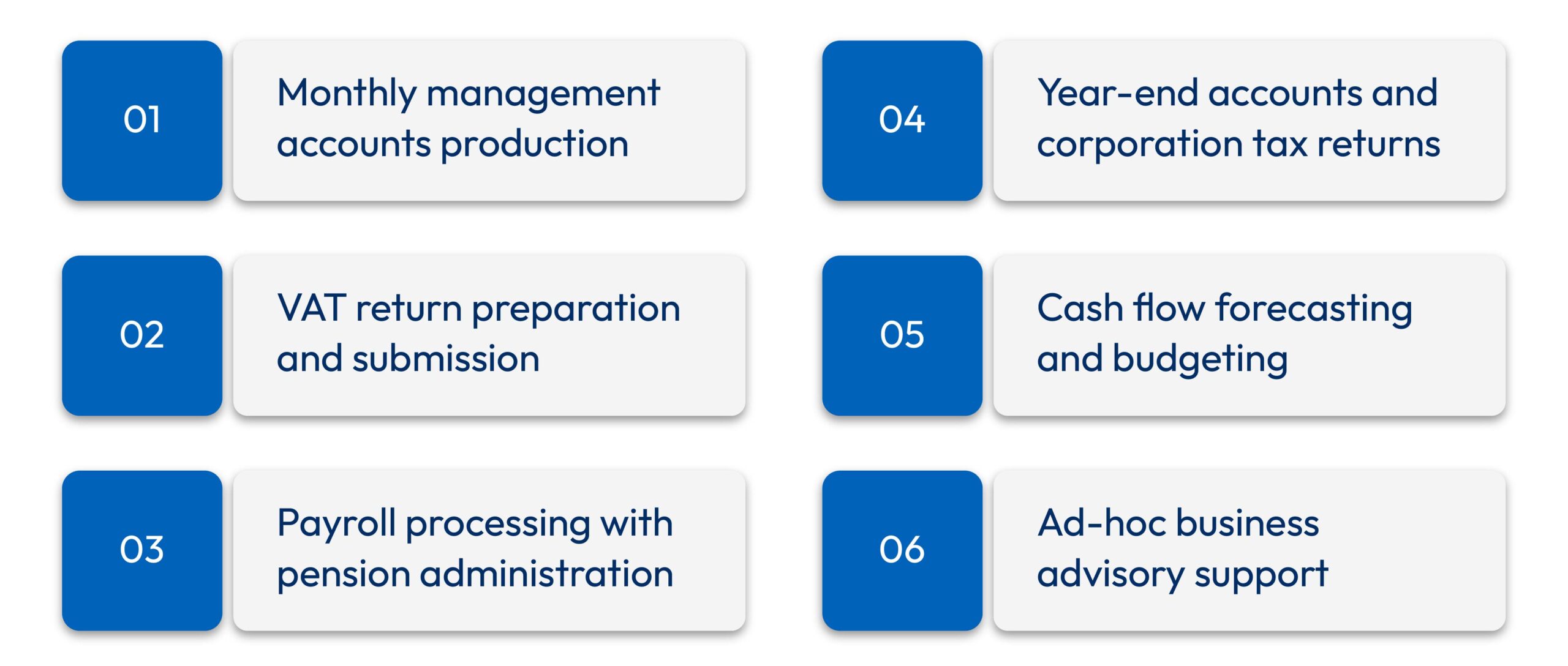
Outsourcing bookkeeping creates predictable monthly costs without surprise bills.
Choosing the Right Accounting Partner
Selecting appropriate outsourced accounting for small businesses requires careful evaluation.
Look for providers with proven SME sector experience.
Technology capabilities should match business complexity and growth plans.
Responsive communication and proactive advice separate excellent from adequate services.
Selection Criteria:
- Qualifications: Chartered or certified accountant status
- Technology: Modern cloud accounting platform expertise
- Sector Knowledge: Understanding of industry-specific challenges
- Service Scope: Comprehensive offerings beyond basic compliance
- Communication: Accessible team with dedicated account management
- Pricing: Transparent fixed monthly fees without hidden charges
Small business accounting success depends heavily on partnership quality.
Managing cash flow after Budget changes
The UK Budget 2025 creates multiple cash flow pressure points.
Higher wages, increased dividend tax and adjusted allowances all affect working capital.
With employer NIC now at 15% and NLW at £12.71, many SMEs are facing significantly higher payroll costs from April 2026.
Proactive cash flow management becomes critical for business survival.
Regular forecasting identifies potential shortfalls before they become crises.
Cash Flow Strategies:
- Model all Budget changes into 12-month forecasts
- Adjust pricing to maintain margin despite cost increases
- Accelerate invoice collection to improve working capital
- Review supplier payment terms for flexibility
- Establish overdraft facilities before need arises
- Model employer NIC and NLW increases into Q1 2026/27 payroll projections immediately
Professional accountants provide sophisticated cash flow modelling tools.
Year-End Planning Considerations
Tax year-end planning takes on added importance with Budget 2025 changes.
The 40% first-year allowance is now active – ensure any qualifying capital investment since January 2026 has been claimed.
Dividend extraction timing affects tax liabilities given April 2026 rate increases.
Capital expenditure timing can optimise new first-year allowance benefits.
Action Checklist:
- Review capital expenditure plans for allowance optimisation
- Model salary-dividend extraction for 2026/27 (new higher dividend rates now apply)
- Assess business rates relief eligibility from April 2026
- Confirm MTD software is operational (mandatory for >£50k income from April 2026)
- Evaluate pension contribution strategies before 2029 cap
- Review payroll for NLW £12.71 and employer NIC 15% compliance
- Consult on BADR/CGT and IHT BPR if planning a business exit or succession
Year-end planning requires expertise that outsourced accounting naturally provides.
Technology Requirements for Post-Budget Compliance
HMRC changes 2025 small businesses face demand robust technology infrastructure.
MTD-compatible software becomes non-negotiable for most businesses.
Cloud-based systems offer flexibility, security and automatic updates.
Integration between accounting, payroll and banking streamlines operations.
Essential Technology Features:
- MTD Compliance: Direct HMRC submission capability
- E-Invoicing Ready: Future-proof for 2029 requirements
- Bank Feeds: Automated transaction import
- Multi-User Access: Team collaboration capabilities
- Real-Time Reporting: Dashboard analytics and KPIs
- Mobile Access: On-the-go financial management
Outsourced accounting for small businesses typically includes appropriate software.
Regional Variations
Budget 2025 provisions apply differently across UK nations.
Business rates changes affect England directly.
Scotland and Wales receive mechanisms to set property income rates.
Northern Ireland maintains separate arrangements for some measures.
Devolved Considerations:
- Property income tax rates may vary in Scotland and Wales
- Business rates systems differ across nations
- Some welfare changes (like two-child limit removal) require local adoption
Small business accounting must account for appropriate jurisdictional rules.
What Should Small Businesses Do Now?
With most Budget 2025 measures now in effect, SMEs should take practical steps to stay compliant and protect profitability.
Key actions include:
- Review payroll costs following employer NIC and National Living Wage increases.
- Check whether Making Tax Digital for Income Tax applies to your business.
- Review your salary and dividend strategy for 2026/27.
- Assess eligibility for business rates relief.
- Update cash flow forecasts to reflect higher operating costs.
- Speak to an accountant if you are planning a business sale or succession.
Conclusion
Conclusion
The Autumn Budget 2025 introduced a range of tax, payroll and compliance changes that continue to affect UK small businesses throughout 2026. From higher employer National Insurance contributions and National Living Wage increases to Making Tax Digital requirements and dividend tax changes, many businesses are facing additional financial and administrative pressures.
The impact of these changes will vary depending on the size, structure and sector of the business. However, taking a proactive approach to tax planning, cash flow management and compliance can help reduce risk and improve financial performance.
With most of the Budget measures now in effect, businesses should focus on reviewing their accounting processes, forecasting future costs and ensuring they remain compliant with HMRC requirements.
For many SMEs, outsourced accounting provides access to specialist expertise, modern technology and ongoing support without the cost of maintaining a large in-house finance team. By seeking professional guidance and planning ahead, small businesses can adapt confidently to the changing financial landscape and position themselves for long-term growth.
FAQs
How do I update cash flow forecasts after Budget changes?
Review all changes that affect your business, including employer NIC increases, National Living Wage rises, dividend tax changes and business rates relief. Update your forecasts to reflect these costs and monitor cash flow regularly using accounting software or scenario planning tools.
How does the Autumn Budget 2025 affect SME accounting workflows?
The Budget increases compliance requirements for many SMEs. Businesses must adapt to expanded Making Tax Digital (MTD) obligations, maintain accurate digital records and prepare for future e-invoicing requirements.
What bookkeeping changes do small businesses need to make in 2026?
Many businesses now need to maintain digital records, submit information more frequently under MTD and use accounting software that integrates with HMRC systems. Streamlined processes can help reduce administrative workload and improve accuracy.
How can I manage new tax and compliance requirements after Budget 2025?
Create a clear implementation plan, review key deadlines, update accounting systems and monitor any changes affecting payroll, tax reporting and record-keeping. Professional accounting support can help businesses stay compliant.
What workflow automation can help small businesses after Budget 2025?
Automated bank feeds, digital receipt capture, transaction categorisation and integrated VAT reporting can save time and improve accuracy. Cloud accounting software can also simplify compliance and financial reporting.
Which HMRC changes affect small businesses the most in 2026?
Key changes include Making Tax Digital for Income Tax, higher employer National Insurance contributions, National Living Wage increases, dividend tax changes and updated capital allowance rules. The impact will vary depending on your business structure and sector.
Do I need new software to comply with the latest tax changes?
Most businesses will benefit from MTD-compatible accounting software. Cloud-based platforms help automate reporting, improve record-keeping and ensure compliance with HMRC requirements as digital tax obligations expand.
How does outsourced accounting help businesses manage Budget changes?
Outsourced accountants help businesses stay compliant, manage reporting requirements, optimise tax planning and keep up with regulatory changes. They also reduce the administrative burden on business owners and internal teams.
What is the timeline for the main Budget 2025 changes?
Key measures began taking effect during 2026, including employer NIC changes, National Living Wage increases and expanded MTD requirements. Additional changes are scheduled through 2027 and beyond, including further MTD expansion and e-invoicing requirements.
Should small businesses outsource accounting after Budget 2025?
Many SMEs choose to outsource accounting to access specialist expertise, reduce administrative workload and manage increasing compliance requirements more efficiently. It can also be more cost-effective than maintaining a larger in-house finance function.
What did the Spring Statement 2026 mean for small businesses?
The Spring Statement 2026 introduced no major new tax measures for SMEs. Instead, it confirmed that previously announced Autumn Budget 2025 reforms would continue as planned, allowing businesses to focus on implementation and compliance.

Parul is a content specialist with expertise in accounting and bookkeeping. Her writing covers a wide range of accounting topics such as payroll, financial reporting and more. Her content is well-researched and she has a strong understanding of accounting terms and industry-specific terminologies. As a subject matter expert, she simplifies complex concepts into clear, practical insights, helping businesses with accurate tips and solutions to make informed decisions.