
Annual accounts are essential for compliance, but they do not help directors manage the business month-to-month. They are usually prepared after the year has ended, which means the numbers are already out of date by the time they are reviewed.
Monthly management accounts matter more because they show what is happening now. They help directors and accountants spot performance issues early, track cash position properly and make decisions based on current figures instead of year-end summaries.
This guide covers:
- Why monthly management accounts matter more than annual accounts
- What annual accounts cannot show clearly
- When outsourced management accounts make sense for SMEs
Key Reasons Monthly Accounts Help More
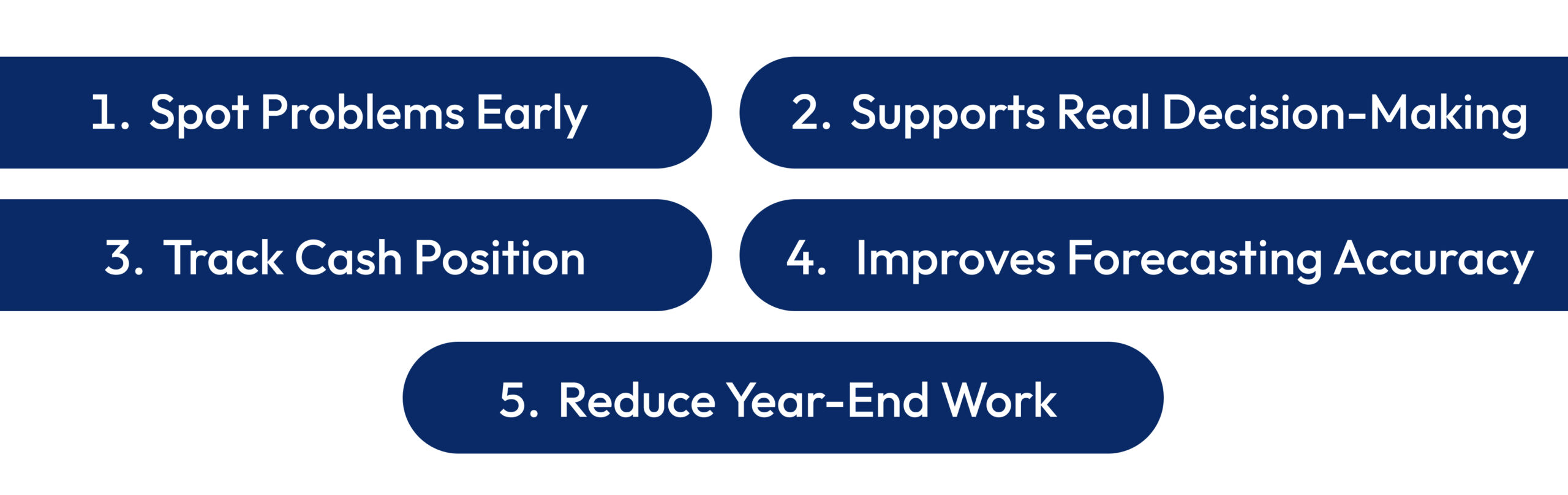
Monthly management accounts matter more because they support timely decision-making. Annual accounts are useful for filing and reporting, but they are not designed to manage performance throughout the year.
Below are the key reasons.
1. Spot Problems Early
Most business issues build gradually. Annual accounts often identify them only after the damage is already done.
Monthly management accounts help spot trends early, such as:
- declining margins
- overhead increasing month-on-month
- debtors building up
- supplier balances rising
- unexpected cost movements
This early visibility helps directors take corrective action while it is still manageable.
2. Supports Real Decision-Making
Directors make decisions every month: pricing, staffing, supplier terms and spending.
Monthly management accounts provide accounting reports for decision making, including:
- performance comparison month-to-month
- service or product profitability
- overhead movement
- key working capital changes
This is what makes management reporting valuable.
3. Track Cash Position
A business can be profitable but still face cash pressure.
Monthly management accounts support business financial health by tracking:
- cash position at month-end
- expected inflows (collections)
- expected outflows (supplier payments, payroll, VAT)
- timing gaps that can create cash strain
This matters especially for accounting for small businesses, where cash cycles can change quickly.
4. Improves Forecasting Accuracy
Forecasts only work when they are based on timely and accurate numbers.
Monthly management accounts improve forecasting accuracy because:
- trends are visible earlier
- actual numbers replace assumptions
- forecast updates become routine (not occasional)
This directly supports business growth planning.
5. Reduce Year-End Work
When reporting happens monthly, issues get corrected monthly.
This reduces:
- reporting issues building up for year-end
- bookkeeping gaps
- VAT coding errors
- missing invoices
- unreconciled balances
Monthly financial statements reduce the clean-up required later, which saves time for both directors and accountants.
What are the Limitations of Annual Accounts?
Annual accounts are still important. They are required for filing and compliance.
But annual accounts have limitations when used to run a business, because:
- they are backward-looking
- they are prepared after the year ends
- they are too high-level for monthly decisions
- they do not reflect trends clearly throughout the year
| Business need | Monthly management accounts | Annual accounts |
|---|---|---|
| Timely financial reporting | Yes | No |
| Financial performance monitoring | Strong | Limited |
| Cash flow visibility | Strong | Weak |
| Forecasting support | Strong | Weak |
| Compliance filing | Not required | Required |
When Outsourcing Management Accounts Make Sense for SMEs?
Many SMEs want monthly reporting but do not have the internal time to produce it consistently. Even when bookkeeping is done, monthly packs may not be prepared.
This is where outsourced management accounts help.
Outsourcing accounting is useful when:
- internal finance capacity is limited
- month-end reporting is delayed
- directors want monthly insight, not just data entry
- forecasting needs more reliable figures
- the business is scaling and needs better control
Outsourcing works best when it combines:
- bookkeeping services
- monthly financial statements
- management reporting and clear commentary
Conclusion
Monthly management accounts matter more than annual accounts because they support the way businesses actually operate month by month. They enable directors to take action early, improve forecasting accuracy, reduce reporting issues, and monitor performance using current financial data.
Annual accounts remain important for statutory compliance, but they are not sufficient for running and scaling a business in 2026. Monthly reporting provides directors and accountants with the visibility needed for stronger financial control and better decision-making.
While annual accounts remain essential for filing with Companies House and reporting to HM Revenue & Customs, they do not provide the timely financial insight required for managing performance throughout the year.
FAQs
Why monthly management accounts are important for SMEs?
They provide monthly financial reporting and help directors identify issues early, especially around cash and margins.
Are annual accounts enough for running a business?
No. Annual accounts support compliance, but they are not designed for monthly decision-making and performance monitoring.
Benefits of monthly management accounts for small businesses
They improve forecasting accuracy, cash visibility and overall management reporting.
How management accounts help business growth?
They support business growth planning by tracking trends and giving reliable numbers to base decisions on.
When should a business start management accounts?
When monthly decisions depend on financial visibility and annual accounts alone no longer provide enough control.

Parul is a content specialist with expertise in accounting and bookkeeping. Her writing covers a wide range of accounting topics such as payroll, financial reporting and more. Her content is well-researched and she has a strong understanding of accounting terms and industry-specific terminologies. As a subject matter expert, she simplifies complex concepts into clear, practical insights, helping businesses with accurate tips and solutions to make informed decisions.