

Many UK business owners underestimate the true cost of in-house bookkeeping. While salary is the most visible expense, HMRC compliance requirements, employer on-costs, technology investment, absence cover, and management oversight create a significantly higher total cost of ownership. This article explores the hidden costs of maintaining in-house bookkeeping within UK SMEs and explains how alternative delivery models can improve cost control, compliance reliability, and operational resilience.
Curious how your current finance setup compares? Request a bookkeeping cost review to benchmark your internal bookkeeping structure against industry cost ranges.
A Practical Breakdown of the Hidden Costs of In-House Bookkeeping for UK SMEs
When calculating the cost of in-house bookkeepers, most businesses focus solely on salary. However, the actual expense extends far beyond this basic figure. Let’s examine what in-house bookkeeping really costs your business:
1. Employee Overhead
Maintaining an in-house bookkeeping team comes with substantial overhead expenses. These include providing workspace, equipment and other resources essential for daily operations.
Office space in the UK costs £300-£1,200 per desk monthly, depending on location. Add to this the cost of computers, furniture, heating, lighting and other utilities.
When combined, these overheads can add thousands of pounds annually to the real cost of employing a bookkeeper expenses that are often overlooked in budgeting decisions.
UK commercial property cost data sourced from regional market reports indicates that workspace remains one of the fastest-rising overhead categories for SMEs, particularly in London and South East England. This makes non-core headcount cost allocation an increasingly material budgeting consideration.
2. Training and Retention
Bookkeeping regulations and best practices constantly evolve, particularly in the UK’s complex tax environment. Continuous professional development is essential but often overlooked when budgeting for in-house bookkeeping.
Annual training costs can range from £500-£2,000 per bookkeeper. Factor in the time away from productive work during training sessions, which represents a significant opportunity cost.
Staff turnover adds further cost through recruitment fees, onboarding time, and temporary productivity gaps. Replacing a finance employee can cost several thousand pounds before they are fully operational.
Additionally, evolving digital compliance frameworks such as Making Tax Digital (MTD) continue to increase competency requirements for finance staff, reinforcing the ongoing investment needed to maintain internal capability.
3. Software Subscriptions
Quality accounting software is essential for accurate bookkeeping. Popular options for UK businesses include:
Xero: £12-£33 per month
QuickBooks: £8-£30 per month
Sage: £12-£40 per month
Additionally, businesses often need specialised add-ons for payroll, inventory, or industry-specific requirements, adding £10-£50 monthly per solution.
As Making Tax Digital (MTD) adoption expands across VAT, Income Tax, and future Corporation Tax phases, businesses frequently require upgraded software tiers, bridging tools, or integration connectors – adding incremental recurring cost beyond base subscriptions.
4. Payroll and Holiday Cover
When your in-house bookkeeper takes annual leave or falls ill, work often piles up or requires temporary replacement. This creates inefficiency in manual bookkeeping processes and can lead to costly errors or delays.
Temporary bookkeeping help in the UK typically costs £150-£250 per day, significantly higher than your regular employee’s daily rate.
Delays in payroll processing or VAT submissions can also expose the business to penalties and reputational risk.
For compliance-critical deadlines such as RTI submissions and VAT filing windows, reliance on single-person internal coverage can introduce operational risk exposure.
5. Opportunity Cost
Perhaps the most significant hidden cost is opportunity cost the value of time business owners spend managing bookkeeping functions rather than focusing on revenue-generating activities.
According to research, small business owners spend an average of 10-15 hours monthly overseeing bookkeeping functions, even with dedicated staff. At an average business owner’s hourly value of £100+, this represents £1,000-£1,500 in lost opportunity every month.
Over a full year, that equates to £12,000–£18,000 of management time that could otherwise be invested in growth, sales, or strategy.
From a management accounting perspective, this represents an implicit labour allocation inefficiency – where senior decision-maker time is absorbed by control activities rather than value-creation activities.
6. Direct Employment Costs
Table showing the breakdown of in-house bookkeeping employment costs including salary, NI contributions, pension, holiday, and sick pay.
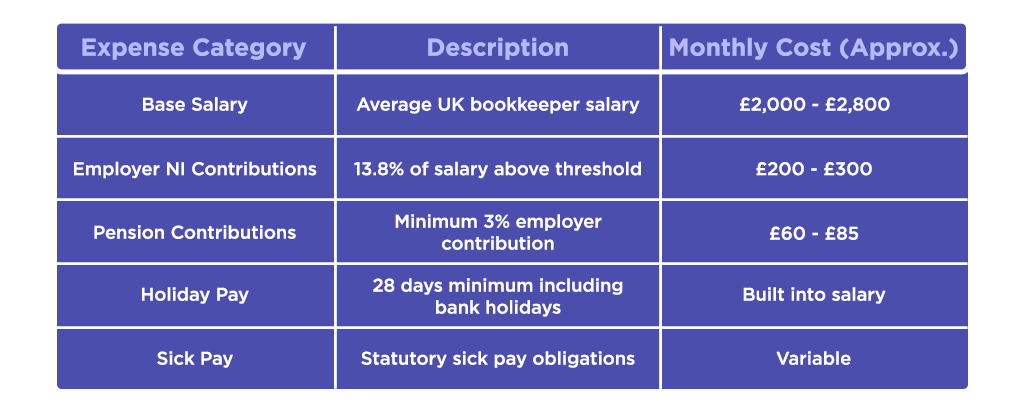
In addition to salary, UK employers must budget for National Insurance contributions, workplace pension contributions, paid holiday entitlement, statutory sick pay, and potential redundancy liabilities.
The In-House vs Managed Bookkeeping Cost Comparison
The comparative cost illustration below reflects typical UK SME finance structure ranges based on salary benchmarks, employer obligations, operational overhead allocation, and managed service pricing models.
| Cost Factor | In-House (Annual) | Managed Model (Annual) | Potential Savings |
|---|---|---|---|
| Direct Employment | £27,000 – £38,000 | N/A | 100% |
| Overhead | £4,000 – £16,000 | N/A | 100% |
| Training | £500 – £2,000 | N/A | 100% |
| Software | £360 – £1,500 | Often included | 80-100% |
| Cover for Absence | £1,500 – £3,000 | N/A | 100% |
| Management Time | £12,000 – £18,000 | £2,000 – £4,000 | 70-80% |
| Service Fees | N/A | £3,600 – £18,000 | N/A |
| Total | £45,360 – £78,500 | £5,600 – £22,000 | £39,760 – £56,500 |
While outsourcing fees vary depending on transaction volume and complexity, businesses typically gain predictable monthly pricing without the volatility of employment-related costs.
Operational Advantages of External Bookkeeping Delivery Models Beyond Cost Reduction
1. Access to expertise
Outsourced bookkeeping providers employ teams of experts who specialise in different aspects of accounting. This means your business benefits from collective expertise rather than relying on a single person’s knowledge for accounting outsourcing for SMEs.
UK tax regulations are complex and frequently change. Professional bookkeeping services stay current with all regulatory updates, reducing your compliance risk.
This is particularly important for VAT compliance, payroll regulations, and upcoming digital reporting requirements under MTD.
This multi-person capability model reduces key-person dependency risk commonly associated with single-employee finance functions.
2. Scalability
As your business grows, your bookkeeping needs will evolve. Outsourced services can easily scale with your business without the disruption of hiring new staff or restructuring your finance department.
This flexibility is particularly valuable for seasonal businesses or those experiencing rapid growth.
3. Improved technology access
Professional providers invest in advanced accounting technology that may be cost-prohibitive for SMEs operating independently.
These tools automate manual processes, reduce errors, and provide enhanced financial insight through structured reporting.
Cloud-based financial ecosystems also support audit trail integrity, automated reconciliation workflows, and real-time reporting visibility for management stakeholders.
4. Focus on core business
By eliminating the need to manage bookkeeping functions internally, business owners and managers can redirect their attention to revenue-generating activities and strategic initiatives.
This refocusing of energy and resources often leads to improved business performance and growth.
The above contributes to outsourced bookkeeping benefits.
How UK businesses are reducing finance department costs?
Many UK businesses are strategically restructuring finance operations to improve efficiency and cost control. Small business bookkeeping expenses can be significantly reduced through selective function redistribution.
This hybrid approach allows companies to retain strategic financial oversight while reallocating transactional and compliance-heavy activities.
This shift aligns with broader UK SME operating model trends favouring variable cost structures over fixed headcount commitments.
Making the transition: How to successfully Outsource your Bookkeeping?
If you’re considering whether outsourcing bookkeeping is cheaper for your small business, follow these steps to ensure a smooth transition:
- Assess your current bookkeeping costs – Calculate all direct and indirect expenses associated with your in-house bookkeeping functions.
- Research qualified providers – Look for firms with expertise in your industry and positive client testimonials.
- Evaluate service packages – Determine which functions to outsource and which (if any) to maintain in-house.
- Plan for knowledge transfer – Develop a comprehensive transition plan to share existing processes and systems with your new service provider.
- Establish clear communication channels – Set expectations for regular updates and financial reporting frequencies.
Need help getting started? Book a consultation to review your current bookkeeping costs and explore a tailored outsourcing solution.
Conclusion
The decision between outsourcing bookkeeping vs hiring a full-time bookkeeper ultimately comes down to understanding the true costs involved. For most UK businesses, particularly SMEs, outsourcing offers significant financial benefits while providing access to expert services.
By recognising the hidden costs of in-house bookkeeping and embracing the outsourcing model, businesses can reduce expenses, improve financial management, and focus resources on core business functions that drive growth and profitability.
Outsource smarter, not harder. Talk to our team to see how much you could realistically save.
FAQs
Is in-house bookkeeping expensive for UK small businesses?
In-house bookkeeping can become costly when total employment expenses are considered, including salary, employer National Insurance, pension contributions, workspace overhead, software licensing, training, and absence cover. For many SMEs, these combined costs exceed initial budgeting assumptions.
What are the main hidden costs of employing a bookkeeper in the UK?
Common hidden costs include employer on-costs, recruitment and retention expenses, workspace overhead, software subscriptions, training requirements, absence coverage, and management supervision time.
Is it risky to rely on a single internal bookkeeper?
Single-person bookkeeping structures can create continuity risk during sickness, annual leave, or staff turnover, potentially impacting payroll processing, VAT submissions, and reporting timelines.
Can small businesses reduce finance costs without reducing control?
Yes. Many SMEs adopt hybrid finance models that retain strategic oversight internally while using external support for transactional processing and compliance tasks.
Why are bookkeeping operating models changing in the UK?
Rising employment costs, digital compliance expansion, cloud accounting adoption, and the need for operational flexibility are driving UK SMEs to reassess traditional finance team structures.

Parul is a content specialist with expertise in accounting and bookkeeping. Her writing covers a wide range of accounting topics such as payroll, financial reporting and more. Her content is well-researched and she has a strong understanding of accounting terms and industry-specific terminologies. As a subject matter expert, she simplifies complex concepts into clear, practical insights, helping businesses with accurate tips and solutions to make informed decisions.