
Accounting firms manage some of the most sensitive business information including client financial records, employee payroll data, tax returns and bank account details.
This makes them attractive targets for cybercriminals seeking valuable personal and financial information that can be sold or exploited.
According to the UK Government’s Cyber Security Breaches Survey 2025, 43% of UK businesses reported cyber security breaches in the past year, with phishing affecting 85% of businesses that identified an attack.
For small accounting firms with limited security budgets, understanding cybersecurity for accounting and payroll systems is essential for protecting client data and maintaining compliance.
Key Takeaways:
- Phishing remains the primary cybersecurity risk for accounting firms in 2026
- Ransomware attacks have doubled from 0.5% to 1% of businesses between 2024-2025
- Payroll cybersecurity risks require separate security measures due to highly sensitive data
- Only 40% of UK businesses use multi-factor authentication (MFA)
- GDPR violations can result in fines up to £17.5 million
- Secure accounting software needs proper configuration to prevent breaches
Top 5 Cybersecurity Risks for Accounting and Payroll Systems
These five cybersecurity risks represent the most pressing dangers facing accounting firms handling sensitive financial data and payroll information.
1. Phishing and Social Engineering Attacks
Phishing targets people rather than technology. Criminals send emails appearing to come from clients, HMRC or colleagues, requesting urgent payment detail changes or access to sensitive information.
The UK Government survey shows phishing affects 85% of businesses that identified an attack.
Artificial intelligence now creates highly convincing messages that mimic writing styles and include accurate client details. During busy periods like tax season, tight deadlines make staff more vulnerable to these attacks.
Protection steps:
- Train staff monthly on recognising suspicious emails
- Verify payment detail changes through phone calls
- Use email filtering systems
- Create simple reporting processes for suspected phishing
2. Ransomware Targeting Accounting Data
Ransomware encrypts your files including client records, working papers and tax returns and demands payment for the decryption key.
Recent variants steal data before encrypting, threatening to publish sensitive client information. Ransomware doubled in prevalence from less than 0.5% of businesses in 2024 to 1% in 2025.
Protection steps:
- Maintain offline backups that ransomware cannot reach
- Test backup restoration quarterly
- Keep all software updated with security patches
- Restrict user permissions to only necessary data
3. Payroll System Security Vulnerabilities
Payroll cybersecurity risks deserve special attention because payroll systems contain highly sensitive personal information including home addresses, dates of birth, bank account numbers, tax codes and medical information.
A single breach affects hundreds or thousands of individuals. Payroll data security requires robust protection during file transfers, data entry and electronic payments.
Protection steps:
- Run payroll software on separate systems from general accounting
- Verify bank account changes through a second channel
- Encrypt all payroll file transfers
- Restrict payroll access to essential staff only
4. Cloud Accounting Software Misconfigurations
Cloud accounting software creates security challenges through misconfigurations, weak access controls and insecure integrations.
Remote work has increased accounting software security concerns, with employees accessing systems from home networks and personal devices.
The UK survey found only 40% of businesses use multi-factor authentication (MFA).
Protection steps:
- Enable multi-factor authentication on all cloud platforms
- Use VPNs for remote access
- Review user permissions quarterly
- Choose providers with clear security certifications
5. Weak Access Controls and Outdated Systems
Many small firms give broad access to staff or allow shared login credentials. When an employee account gets compromised, attackers gain access to everything. Password reuse allows one breach to compromise multiple accounts. Outdated software no longer receives security patches, leaving known vulnerabilities open.
Protection steps:
- Implement role-based access controls
- Require complex, unique passwords
- Enable automatic updates
- Replace unsupported software immediately
Practical Security Measures for Accounting Firms
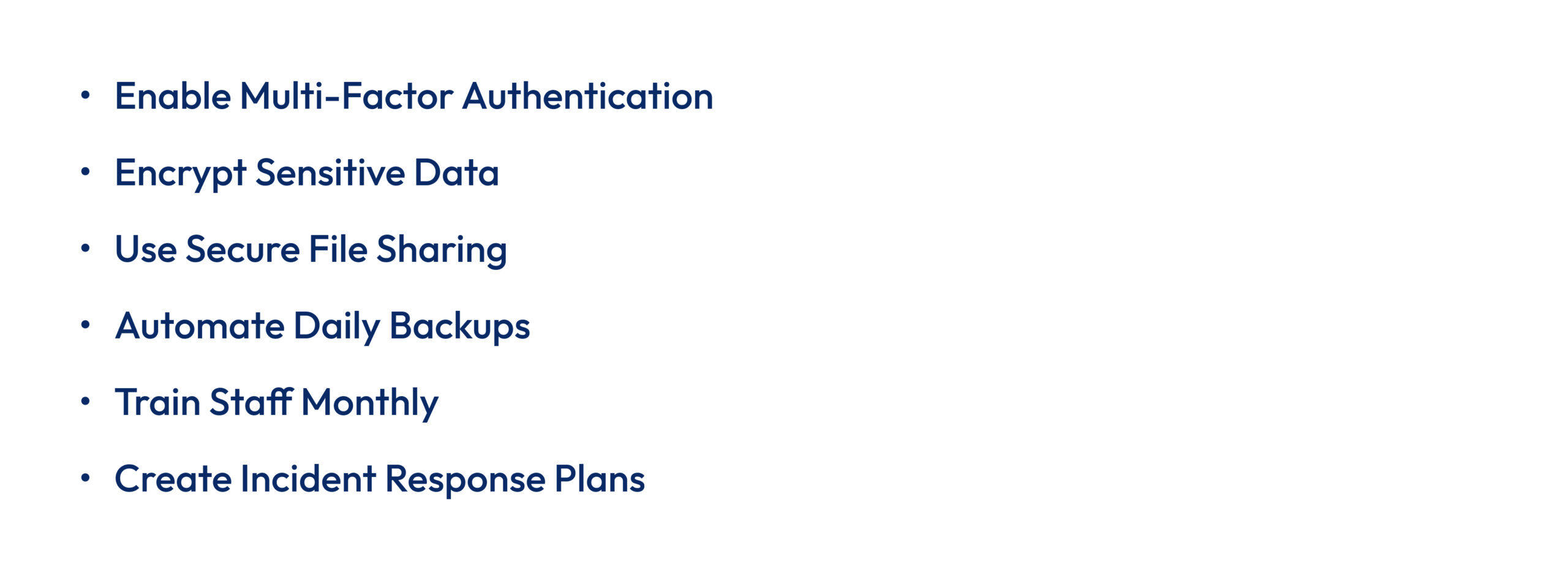
- Enable Multi-Factor Authentication: Only 40% of UK businesses use it, yet it blocks most automated attacks. Enable multi-factor authentication for all accounting systems containing client data.
- Encrypt Sensitive Data: Encrypt sensitive data protection both when stored and during transmission. Use full disk encryption for laptops and mobile devices.
- Use Secure File Sharing: Stop emailing sensitive documents. Use secure payroll processing portals and client portals that encrypt files and create audit trails.
- Automate Daily Backups: Store one backup set offline. Test restoration quarterly to ensure backups work when needed.
- Train Staff Monthly: Schedule regular security briefings covering recent threats and best practices for accountants. Employee awareness is your first defence against phishing.
- Create Incident Response Plans: Document what to do if you discover a security incident, including who to notify and how to contain breaches.
GDPR Requirements for Accounting Firms
GDPR and accounting compliance requires firms to protect client information through encryption, role-based access controls and regular risk assessments.
You must report significant data breaches to the ICO within 72 hours of discovery. This means having clear incident response procedures ready before a breach occurs.
GDPR violations can result in fines up to 4% of annual turnover or £17.5 million, whichever is higher. Recent enforcement actions demonstrate regulators will use these powers with fines running into millions showing the consequences of inadequate security. Beyond financial penalties, breaches damage client trust and lead to business loss.
Selecting Secure Accounting Software
When choosing encrypted accounting software, prioritise these essential security features:
- End-to-end encryption for data storage and transmission
- Role-based access control limiting user permissions
- Comprehensive audit logs tracking all data access
- Automatic security updates and patch management
- Multi-factor authentication options for all users
- Regular third-party security audits and certifications
Ask vendors critical questions before committing:
- Where is data physically stored and under which jurisdiction?
- Who can access client data and what controls prevent unauthorised access?
- How often are security updates applied to the platform?
- What happens if the vendor suffers a data breach?
- What security certifications and compliance standards do they meet?
Reputable vendors provide clear documentation of their security practices and answer these questions transparently.
UK Compliance Requirements
All accounting firms handling personal data must register with the ICO and comply with GDPR. Firms must maintain written information security plans documenting how they protect data, including risk assessments, security measures, staff training and incident response procedures.
FCA-regulated firms face additional cybersecurity requirements around operational resilience. The government’s Cyber Governance Code of Practice sets board-level expectations for cybersecurity, linking to the NCSC Board Toolkit for senior leadership guidance.
Your 30-Day Cybersecurity Action Plan
Use this checklist to secure your accounting firm systematically over the next month.
Week 1: Authentication & Access
- [ ] Enable multi-factor authentication on all accounting software
- [ ] Enable multi-factor authentication on email accounts
- [ ] Review user permissions and remove unnecessary access
- [ ] Change all shared passwords to individual accounts
Week 2: Data Protection
- [ ] Verify encryption is enabled on all laptops and mobile devices
- [ ] Set up secure client portal for file sharing
- [ ] Stop using email attachments for sensitive documents
- [ ] Review cloud accounting software security settings
Week 3: Backup & Recovery
- [ ] Set up automated daily backups
- [ ] Create offline backup storage separate from main network
- [ ] Test backup restoration process
- [ ] Document backup procedures
Week 4: Training & Planning
- [ ] Schedule monthly security training sessions
- [ ] Create phishing reporting procedure
- [ ] Write incident response plan
- [ ] Register with ICO if not already done
- [ ] Review and update information security plan
Conclusion
Protecting your accounting and payroll systems from emerging cybersecurity risks requires a systematic approach combining technology, training and clear procedures. Small accounting firms can significantly reduce their vulnerability by implementing basic security measures that address the most common attack methods.
Start with the 30-day action plan to build strong foundations in authentication, data protection, backup systems and staff training. Cybersecurity for accounting and payroll systems is an ongoing responsibility, but taking these first steps puts you in a stronger position to protect client trust and maintain compliance with UK data protection requirements.
Frequently Asked Questions
Why are payroll systems targeted by hackers?
Payroll systems contain verified bank details and national insurance numbers that enable identity theft and fraud on criminal markets.
How secure is cloud accounting software?
Cloud software can be very secure when properly configured with encryption, multi-factor authentication and regular audits from reputable providers.
What happens if payroll data is breached?
You must notify the ICO and affected individuals within 72 hours, facing potential fines up to £17.5 million plus client loss.
How can accountants improve cybersecurity?
Enable multi-factor authentication, encrypt data, train staff regularly, maintain tested backups and use secure file sharing methods.
Is payroll outsourcing more secure?
Outsourcing can improve security with reputable providers, though you remain responsible for verifying their security practices and protecting client data.

Parul is a content specialist with expertise in accounting and bookkeeping. Her writing covers a wide range of accounting topics such as payroll, financial reporting and more. Her content is well-researched and she has a strong understanding of accounting terms and industry-specific terminologies. As a subject matter expert, she simplifies complex concepts into clear, practical insights, helping businesses with accurate tips and solutions to make informed decisions.