
If you run a small business or a limited company in the UK, you have probably come across the idea that AI will soon take over accounting roles. Software companies are making some big claims, so it is fair to wonder whether you still need a human accountant or whether software can handle it all.
The short answer is no, AI cannot replace accountants in 2026. But that does not mean AI has no place in accounting roles; it simply does not belong in the way some people imagine.
Key Takeaways
- AI can sometimes produce incorrect answers without clearly flagging uncertainty. If you rely on those answers, you remain responsible for any HMRC penalties, not the software.
- Making Tax Digital (MTD) for Income Tax applies to sole traders and landlords with qualifying income over £50,000. Quarterly submissions mean mistakes can be carried forward if they are not spotted early.
- Areas such as VAT partial exemption, IR35, and R&D tax claims require professional judgement. AI cannot reliably apply rules to complex real-world situations on its own.
- A qualified accountant is legally responsible for their work and can be held accountable. AI software has no legal responsibility or liability.
What AI can actually do in accounting roles?
AI accounting software has come a long way. It is genuinely useful for a number of everyday tasks and it does them quickly and consistently.
Here is what AI handles well:
- Processing standard invoices and receipts
- Matching transactions automatically
- Generating basic reports from clean data
- Automating routine data entry
- Flagging duplicate entries or obvious mistakes
- Handling recurring journal entries
These are real time-savers. If your books involve a lot of repetitive, straightforward tasks, AI tools for accountants can speed things up significantly. Cloud accounting software that uses AI can cut down hours of manual work each week.
But here is the thing, being fast at processing data is not the same as understanding what that data means.
Where AI falls short?
This is the part that matters most for UK business owners and limited company directors.
AI works well when conditions are predictable. Accounting, however, is rarely that simple. The moment things get even slightly complicated, the gaps in AI become very clear.
What AI cannot do:
- Understand your specific business and how it operates
- Handle unusual or one-off transactions
- Make professional judgement calls
- Explain decisions to you or to HMRC
- Keep up with regulatory changes and apply them correctly to your situation
There is also a problem called AI hallucination. This is when AI produces incorrect information but presents it with complete confidence as if it is entirely sure. There is no warning, no flag, no “I am not certain about this.”
In accounting, this is a serious risk. A wrong VAT calculation or an incorrectly filed return can lead to HMRC penalties and the software will not be the one paying them. You will.
Real situations AI simply cannot manage
These are not hypothetical scenarios. They are the kinds of situations that come up regularly for most UK businesses.
| Situation | Can AI handle it? | Why not |
|---|---|---|
| Client asks why an expense was classified as capital | No | It needs explanation and judgement. |
| Industry-specific VAT scheme adjustments | No | It requires specialist knowledge. |
| Restating a prior quarter after a rule change | No | It needs regulatory interpretation. |
| Complex partial exemption VAT | No | It requires multi-step professional judgement. |
| Standard monthly payroll | Partially | Exceptions still need human review. |
| Basic bank reconciliation on clean data | Yes | It is a routine matching task. |
Clients need explanations. They need someone who understands their business. They need advice that is specific to their situation not a generic output from a system that has never met them.
Why UK Tax Compliance still needs a Human?
For limited companies and small businesses in the UK, getting your tax right is not optional. HMRC’s Making Tax Digital programme is expanding and the requirements around VAT, corporation tax and income tax self-assessment are getting more detailed every year.
Areas where AI cannot be trusted on its own:
- VAT partial exemption calculations especially for businesses with mixed supplies
- Multi-jurisdiction transactions relevant for any business selling into the EU post-Brexit
- Prior period corrections which need careful handling to avoid disputes with HMRC
- R&D tax credit claims eligibility requires professional assessment
- IR35 assessments still one of the most contested areas for Ltd company directors
Making Tax Digital for Income Tax: Why human oversight is still important?
MTD for Income Tax has changed how sole traders and landlords report income to HMRC. Instead of a single annual Self-Assessment return, you now need to submit digital records quarterly, followed by a final declaration at year end.
The phased introduction is based on gross income, before expenses and not profit:
- From April 2026: Sole traders and landlords earning over £50,000
- From April 2027: Those earning over £30,000
- From April 2028: Those earning over £20,000
Limited companies are not in scope. MTD for Corporation Tax has no confirmed start date.
This is where AI alone is not enough. Software can process your records, but checking accuracy, catching mistakes before they reach HMRC and making the right calls each quarter still needs a qualified person.
That is the accountant’s job. Four quarterly errors are harder to fix than one annual mistake and HMRC’s penalties apply from the moment you are mandated.
What an Accountant brings that AI cannot?
The conversation about accounting technology trends tends to focus on what AI can do. But it is worth thinking clearly about what a qualified accountant actually provides because it goes well beyond processing numbers.
This is not just the view of individual practitioners. ICAEW, in its Direction 2030 strategy, has stated clearly that “those roles using AI will be less at risk than those that do not” framing AI as a tool that strengthens the profession rather than one that displaces it.
The human advantage:
- Trust built over time: A good accountant knows your business, not just your latest figures.
- Regulatory knowledge: HMRC guidance changes, and a qualified professional keeps up and applies it correctly to your situation.
- Strategic advice: From dividend planning to cash flow, this needs experience and judgement, not just pattern recognition.
- Crisis support: When HMRC sends an enquiry letter, you need a person in your corner.
- Professional accountability: A regulated accountant carries professional liability; AI software does not.
New technology in accounting has changed how work gets done. But it has not changed what clients actually need when things go wrong.
| What needs doing | AI accounting software | Human accountant |
|---|---|---|
| Routine data processing | Very fast | Slower |
| Complex VAT decisions | Poor | Strong |
| Explaining figures to a client | Cannot do this | Core part of the job |
| Responding to an HMRC enquiry | Cannot do this | Essential |
| Adapting to new regulations | Very limited | Ongoing |
| Spotting errors in its own work | Cannot self-audit | Professional duty |
| Strategic business advice | Cannot do this | High value |
| Professional liability | None | Regulated and accountable |
The Smarter Approach: AI and Humans Working Together
The most effective accounting outsourcing firms in the UK are not choosing between AI and people. They are using both, in the right places.
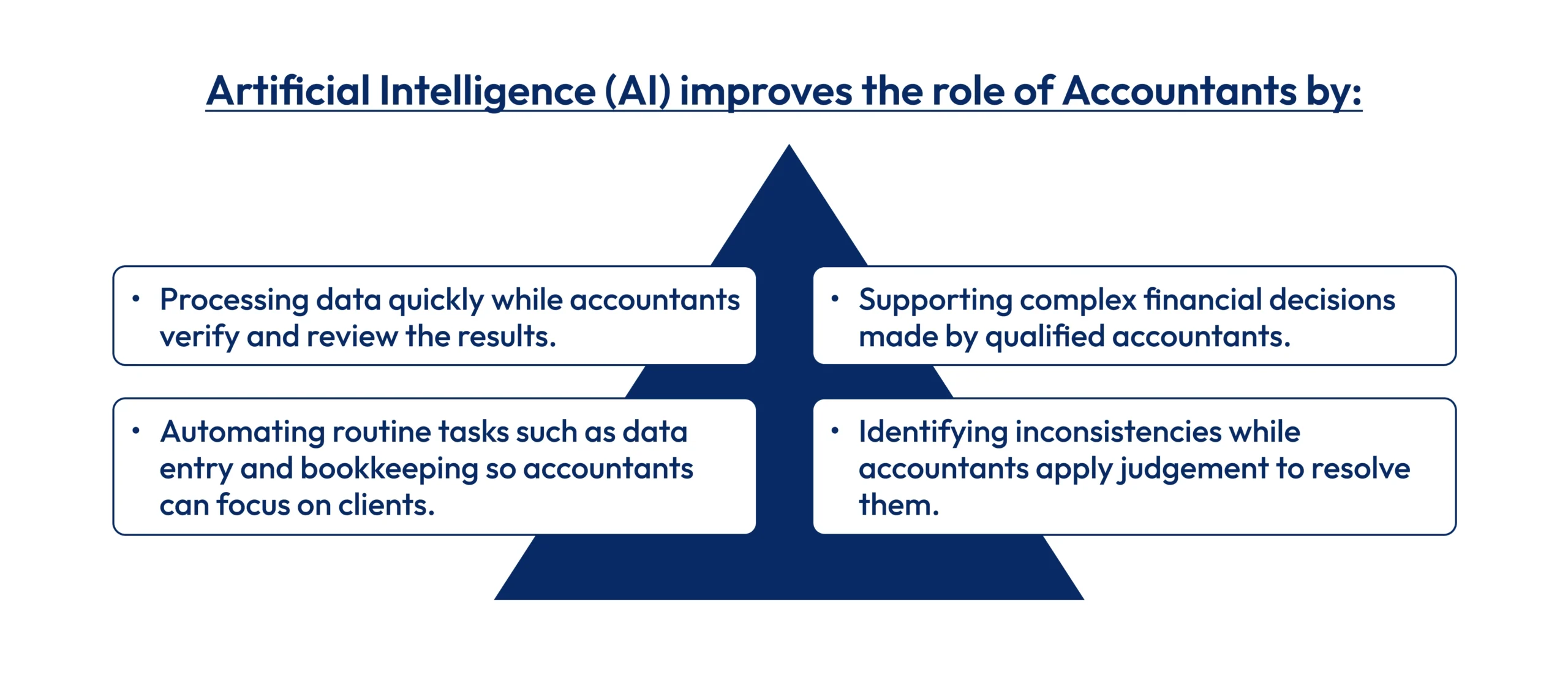
AI takes care of:
- Initial data capture and processing
- Transaction matching
- Draft standard reports
- Routine journal entries
Accountants focus on:
- Checking AI outputs for errors
- Making professional judgement calls
- Talking to clients and explaining the numbers
- Handling complex VAT and tax decisions
- Signing off on compliance
This is how bookkeeping automation services work best. AI does the repetitive legwork. Qualified accountants do the thinking, the checking and the advising.
At Outbooks, this is exactly how we work. AI handles the basics. Our qualified accountants review every output, apply professional judgement and make sure everything is fully compliant. The result is faster turnaround without cutting corners on accuracy or accountability.
The future of accounting is not AI versus people. It is AI and people working together and that combination delivers better results than either one alone.
Conclusion
AI has changed how much of the routine work in accounting is done, but it has not changed what UK businesses need. When something goes wrong, or when a decision requires judgement, you still need a qualified accountant, not just software.
In 2026, the firms getting this right are using AI for repetitive tasks and relying on accountants for the work that needs expertise, accuracy, and accountability.
At Outbooks, we follow that approach. AI supports day-to-day processing, while our ACCA-qualified accountants review the work, manage compliance, and handle complex matters. The result is faster turnaround without compromising on accuracy.
Need reliable accounting support? Visit outbooks.co.uk, call +44 330 057 8597, or email info@outbooks.co.uk.
Frequently Asked Questions
Will AI replace accountants in the UK?
Not in the foreseeable future. AI can automate routine tasks, but UK tax compliance, professional judgement and client relationships still need qualified human accountants. The role is changing, not disappearing.
What is AI accounting and is it reliable?
AI accounting uses machine learning to automate data entry, reconciliation and basic reporting. It is reliable for tasks but can produce errors on complex work, so human review is still essential for compliance.
Can AI handle VAT returns for UK businesses?
It can help with data collection and standard figures, but complex VAT situations partial exemptions, multi-jurisdiction sales, prior period corrections need professional oversight to avoid HMRC penalties.
Does Making Tax Digital apply to limited companies?
Not yet, MTD for Income Tax applies to sole traders and landlords only. A separate MTD for Corporation Tax programme is planned but has no confirmed start date. Ltd company directors are not in scope for the current rollout.
Is bookkeeping automation worth it for small businesses?
Yes, for routine and repetitive tasks. But combining it with a qualified accountant gives you the efficiency gains without the compliance risk that comes from relying on AI alone.
How is outsourcing accounting with AI different from doing it in-house?
Outsourced accounting services that use the AI and human model give you qualified professionals and efficient processing at a lower cost than a full in-house team, with professional liability included.
What accounting industry trends should UK directors know about in 2026?
Making Tax Digital expansion, AI-assisted bookkeeping and specialist compliance outsourcing are the three biggest shifts this year. The common thread is that technology supports accountants it does not replace them.

Parul is a content specialist with expertise in accounting and bookkeeping. Her writing covers a wide range of accounting topics such as payroll, financial reporting and more. Her content is well-researched and she has a strong understanding of accounting terms and industry-specific terminologies. As a subject matter expert, she simplifies complex concepts into clear, practical insights, helping businesses with accurate tips and solutions to make informed decisions.