

Payroll accuracy relies on applying the correct tax code to every employee. If the wrong code is used, Income Tax can be calculated incorrectly, leading to payroll adjustments, employee queries and unnecessary administrative work.
While many tax codes remain the same throughout an employee’s time with a business, some are applied only in specific circumstances. The 0T tax code is one of them, often raising questions for employers and accountants about when it should be used and how it affects payroll.
Knowing when this tax code should be applied helps businesses process payroll correctly, avoid unnecessary adjustments and meet HMRC requirements.
This guide explains the situations in which employers are expected to use it and how it affects payroll.
Key Takeaways
- The 0T tax code removes the Personal Allowance, so tax is calculated on all taxable pay using the standard PAYE tax bands.
- Use the 0T tax code only in HMRC-approved situations, such as missing starter information, multiple income sources or post-employment payments.
- 0T and BR are different tax codes. 0T uses the standard Income Tax bands, while BR taxes all earnings at the basic rate.
- Avoid common payroll mistakes, including unauthorised tax code changes, missed HMRC notices and incorrect use of BR instead of 0T.
- Verify payroll records before responding to employee queries and update payroll when HMRC issues a revised tax code.
How the 0T Tax Code works in Payroll?
Most PAYE tax codes apply an employee’s Personal Allowance before calculating Income Tax. The 0T tax code doesn’t. Instead, tax is calculated on the employee’s full taxable pay from the first pound earned, while still using the normal Income Tax bands.
0T is often confused with the BR tax code because neither applies the Personal Allowance. However, they calculate tax differently, as shown in the table below:
| Type | 0T | BR |
|---|---|---|
| Personal Allowance applied | None | None |
| Tax calculation method | Applies the standard 20%, 40% and 45% Income Tax bands as earnings increase. | Flat 20% on all taxable pay |
| Best suited to | Employees at any income level, including higher-rate taxpayers | Basic-rate taxpayers only |
| Risk of under- or over-deducting tax | Lower, as tax is calculated using the correct tax bands | Higher, particularly for higher-rate taxpayers |
This distinction matters because using the wrong tax code can lead to incorrect PAYE deductions. That creates extra payroll corrections, unnecessary queries from employees and, in some cases, compliance issues that could have been avoided.
When are employers required to apply the 0T Code?
HMRC applies the 0T tax code in different situations and each has its own payroll requirements. Knowing when the code should be used helps employers process payroll accurately and stay compliant.
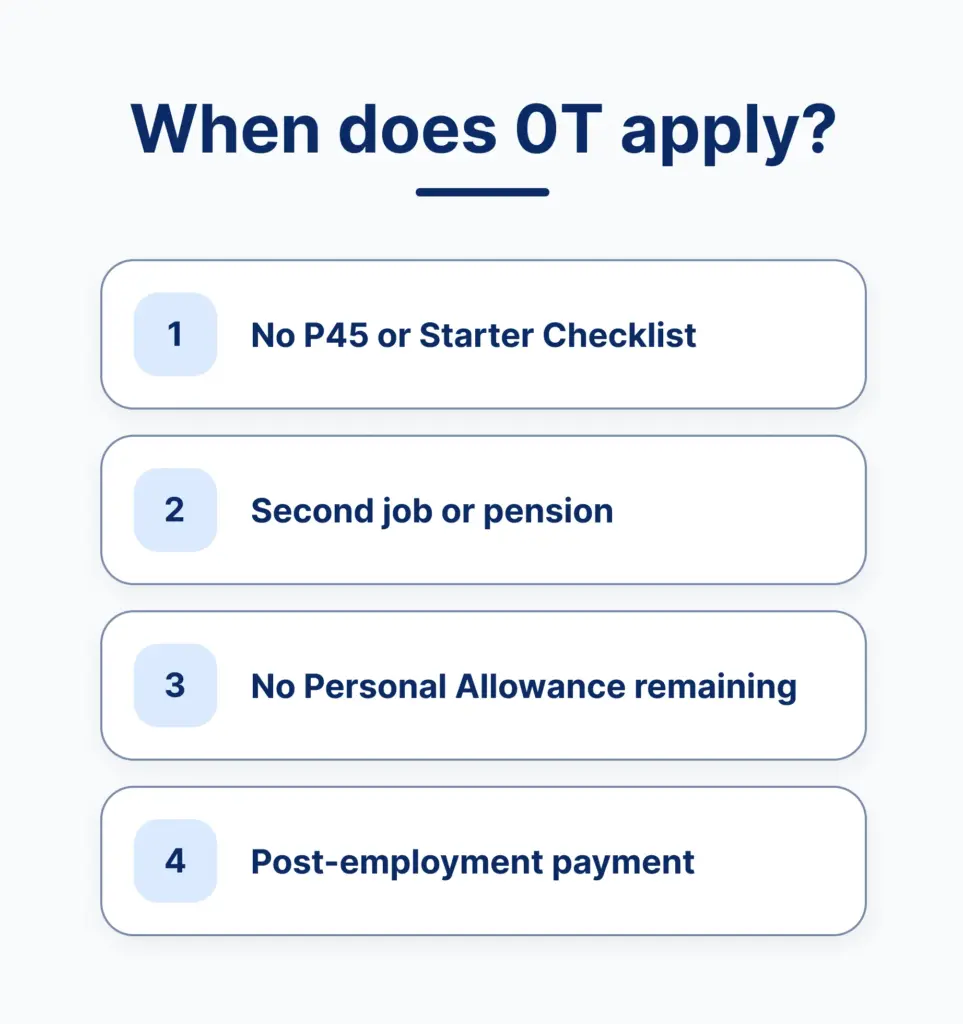
The following are the key situations where employers are required to use the 0T tax code:
1. A new starter hasn’t provided a P45 or completed the Starter Checklist
If a new employee hasn’t provided a P45 or completed the HMRC Starter Checklist before their first payday, employers must apply the 0T tax code on a non-cumulative (W1/M1) basis. Once the required information is received or HMRC issues a new tax code, payroll can be updated accordingly.
2. The employee has more than one source of income
An employee’s Personal Allowance can only be used once. If it’s already applied to their main job, a second job or pension is often taxed using 0T (or, in some cases, BR) because the allowance has already been allocated elsewhere.
3. The employee has no Personal Allowance remaining
Personal Allowance starts to reduce once adjusted net income exceeds £100,000. It falls by £1 for every £2 earned above this threshold and is fully withdrawn at £125,140. At this stage, 0T is the correct tax code because the employee is no longer entitled to a Personal Allowance.
4. Payments made after employment has ended
If a business makes a payment after an employee has left, such as a bonus, commission or payment for unused holiday and the employee’s P45 has already been issued, that payment must be taxed using the 0T code on a non-cumulative basis. This has been the PAYE requirement since a 2011 amendment to the regulations.
Common payroll mistakes when applying the 0T Tax Code
Even when payroll teams understand when the 0T tax code should be used, mistakes can still happen during payroll processing. The following are some of the most common mistakes businesses and accountants should avoid:
1. Changing the tax code without HMRC authorisation
Employees may question why more tax has been deducted and ask for their tax code to be changed. However, employers should only update a tax code when they receive an HMRC coding notice or the employee provides valid starter information. Making changes based on assumptions can result in incorrect PAYE calculations.
2. Missing HMRC coding notices
The 0T tax code is often temporary. Once HMRC issues a revised tax code, payroll should be updated from the effective date. Failing to apply the new code can lead to continued incorrect tax deductions and unnecessary payroll corrections.
3. Using BR instead of 0T
Although both tax codes do not apply a Personal Allowance, they calculate Income Tax differently. Using BR where 0T is required can result in incorrect deductions, particularly for higher-rate taxpayers or employees whose income crosses multiple tax bands.
4. Overlooking post-employment payments
Payments made after an employee has left, such as bonuses or outstanding holiday pay, have separate PAYE rules. Applying the previous tax code instead of the required 0T code can result in non-compliant payroll processing.
How should employers respond to employee queries about the 0T Tax Code?
Employees can question the zero tax code when they notice a higher tax deduction on their payslip. Before responding, employers should confirm that the tax code has been applied correctly using the available payroll records and HMRC information.
The following steps provide a structured process for resolving employee queries while maintaining accurate and compliant payroll:
- Explain why the tax code has been applied: Start by explaining the reason for the code, such as missing starter information, another source of income or an HMRC coding notice. This helps employees understand why their tax deduction may have changed.
- Review the payroll records: Confirm that the tax code matches the employee’s payroll history and the information available when payroll was processed.
- Check HMRC coding notices and employee documentation: Review any HMRC coding notices, along with the employee’s P45 or Starter Checklist, to confirm the tax code has been applied correctly.
- Advise the employee on the next steps: If the tax code is correct, explain that no further action is needed unless HMRC issues a revised coding notice. If the employee believes the code is incorrect, advise them to contact HMRC, as only HMRC can review their tax position and authorise a coding change.
- Update payroll when a new coding notice is received: If HMRC later issues a revised tax code, apply it in the next available payroll run so future PAYE deductions are calculated correctly.
Conclusion
Applying the 0T tax code correctly is an important part of PAYE compliance. Understanding when it should be used, avoiding common payroll mistakes and responding to employee queries consistently can help businesses process payroll accurately and reduce unnecessary corrections.
If your business needs support managing PAYE tax codes or payroll compliance, Outbooks supports UK businesses with payroll processing, including tax code checks for new starters, employee benefits and multiple sources of income. To discuss your payroll requirements, call +44 330 057 8597 or email info@outbooks.co.uk.
Frequently Asked Questions (FAQs)
1. Is 0T an emergency tax code?
No. The 0T tax code is often temporary, but it can also be the correct long-term tax code if the employee has no Personal Allowance available.
2. Is the 0T Tax Code non-cumulative?
Not always. The 0T tax code can be applied on either a cumulative or a non-cumulative basis, depending on HMRC’s instructions. If it includes W1 or M1, tax is calculated only for the current pay period. Without W1 or M1, it is applied on a cumulative basis.
3. Does 0T affect National Insurance or benefits?
No, the 0T tax code only affects Income Tax calculations. It does not change National Insurance contributions or directly affect its benefits.
4. Can an employer change a 0T Tax Code?
No. Employers should only change a tax code when they receive an HMRC coding notice or valid starter information. They should not change a tax code at an employee’s request without HMRC authorisation.
5. Who is liable if an employer applies the 0T code incorrectly?
In most cases, the employer is responsible. If the 0T tax code is applied incorrectly, HMRC will normally recover any underpaid PAYE from the employer. The employee becomes liable only in limited circumstances decided by HMRC.

Parul is a content specialist with expertise in accounting and bookkeeping. Her writing covers a wide range of accounting topics such as payroll, financial reporting and more. Her content is well-researched and she has a strong understanding of accounting terms and industry-specific terminologies. As a subject matter expert, she simplifies complex concepts into clear, practical insights, helping businesses with accurate tips and solutions to make informed decisions.