

Managing VAT payments can put serious pressure on business cash flow especially for UK importers and growing SMEs. While the original COVID VAT deferral scheme has ended, businesses in 2026 can still legally delay or manage VAT payments through options like Postponed VAT Accounting (PIVA), import VAT deferment accounts, and HMRC Time to Pay arrangements. Understanding how deferred VAT works today can help your business improve cash flow, avoid penalties, and stay compliant with HMRC rules.
Understanding Deferred VAT in 2026
Deferred VAT is a system allowing businesses to delay certain VAT payments. HMRC VAT deferral schemes provide breathing space for cash flow management. This becomes particularly important for small business operations.
The UK government previously offered pandemic VAT relief during COVID-19. Over 600,000 businesses deferred payments worth £34 billion. These schemes have now closed for new applications.
Current tax deferral options for UK businesses include import VAT deferment. There are also Time to Pay arrangements for struggling companies. Professional advice helps determine the best approach.
Related post – Deferred Tax
Current VAT Thresholds for 2025-26
The VAT registration threshold for 2025-26 remains £90,000. This increased from £85,000 in April 2024. The deregistration threshold stays at £88,000.
Current VAT rates are 20% standard rate, 5% reduced rate and 0% zero rate. These rates apply across all VAT deferment schemes. Understanding VAT liability helps businesses plan payments effectively.
| VAT Threshold Type | 2025–26 Amount | Previous Amount | Change |
|---|---|---|---|
| Registration | £90,000 | £85,000 | +£5,000 |
| Deregistration | £88,000 | £83,000 | +£5,000 |
| Standard Rate | 20% | 20% | No change |
| Reduced Rate | 5% | 5% | No change |
How Does Deferred VAT Work in the UK?
Deferred VAT works by postponing payment obligations to future dates. Import businesses commonly use VAT deferment accounts with HMRC. This improves cash flow management for small business operations.
The process involves applying for specific HMRC schemes. Monthly payments replace individual transaction charges. Direct Debit arrangements ensure automatic collection on agreed dates.
Postponed VAT accounting (PIVA) offers another option. This allows VAT registered importers to defer payments. VAT appears on returns rather than being paid upfront.
Types of VAT Deferment Available in 2026
Import VAT Deferment Accounts
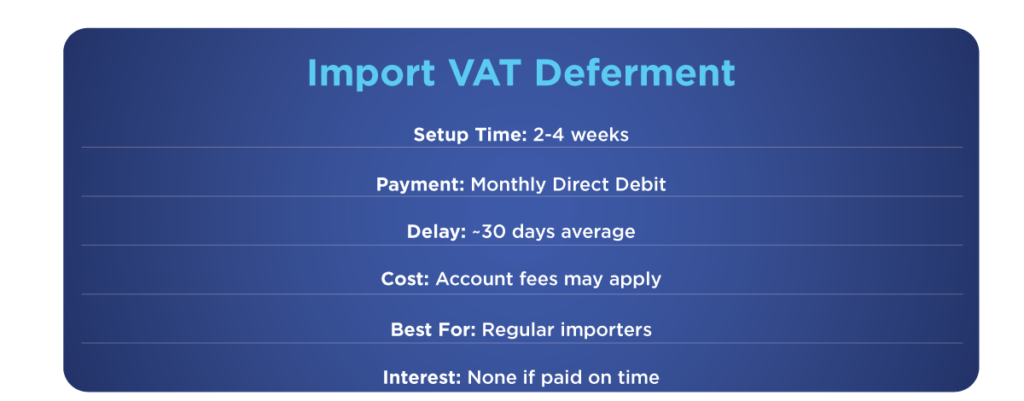
Import VAT deferment suits businesses regularly importing goods. You need a deferment account with HMRC for this option. Monthly Direct Debit payments replace individual shipment charges.
The account accumulates import duty and VAT monthly. Payment occurs around the 15th of the following month. This typically delays payment by 30 days on average.
Benefits include reduced administrative burden and improved cash flow. One monthly payment replaces multiple individual transactions. This helps cash flow management for small business importers.
Postponed VAT Accounting (PIVA)
PIVA allows VAT registered businesses to defer import VAT. No upfront payment is required during import clearance. VAT appears on your next VAT return instead.
This scheme works automatically for eligible businesses. No special account setup is required with HMRC. Import VAT can be reclaimed on the same return.

Time to Pay Arrangements
HMRC payment plans help businesses in temporary difficulty. These arrangements spread VAT payments over agreed periods. Interest charges may apply depending on circumstances.
Applications require detailed financial information about your business. HMRC assesses ability to pay before approving arrangements. Professional advice improves application success rates.

Can My Business Still Defer VAT in 2026?
The COVID-19 VAT deferment scheme closed in 2021. New applications are no longer accepted for pandemic relief. However, other VAT deferment options remain available.
Import businesses can still apply for deferment accounts. VAT registered companies can use postponed VAT accounting. Time to Pay arrangements help businesses facing difficulties.
Should small businesses defer VAT payments? This depends on individual circumstances. Regular importers benefit most from deferment accounts. Occasional importers might prefer PIVA arrangements.
Read Also – Outsourced Accounts Receivable Management – Overcome AR Challenges Like a Pro!
How to Apply for a VAT Deferral with HMRC
Application Process for Import Deferment
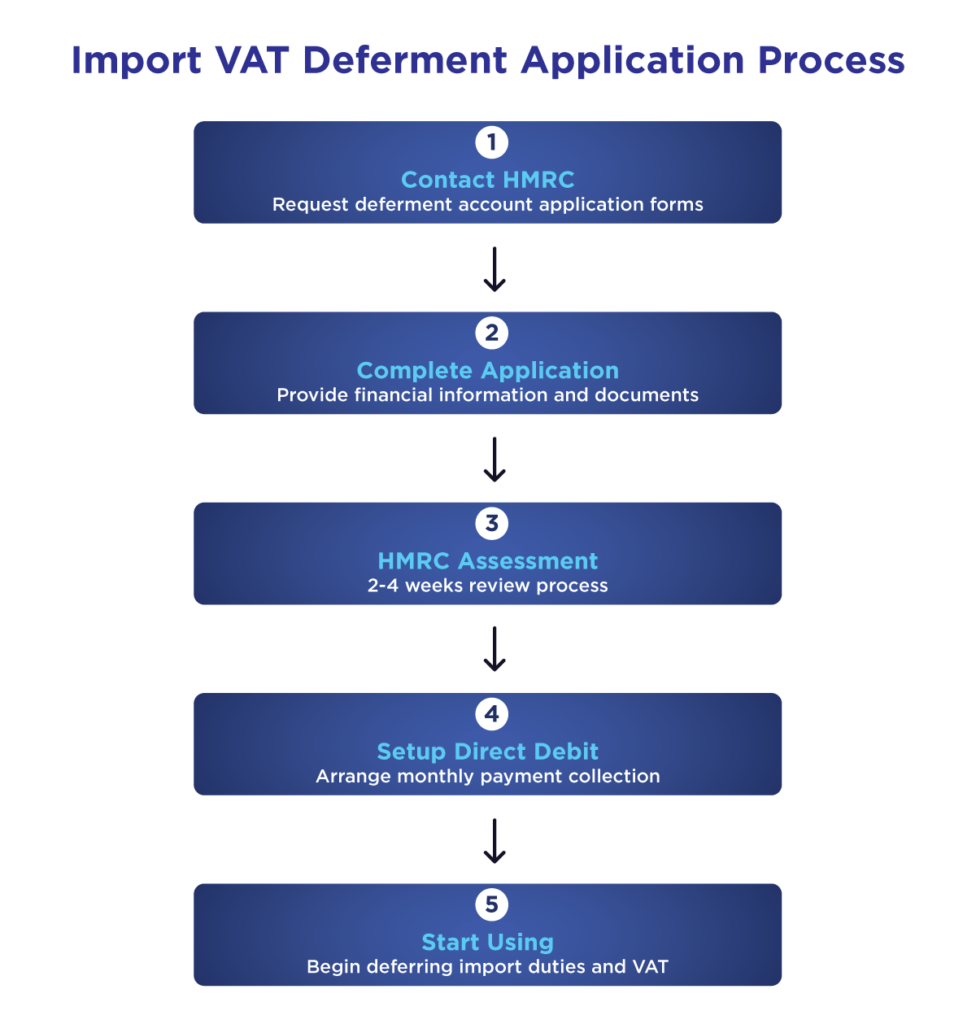
Contact HMRC to request a deferment account application. Complete the required financial information accurately. Submit supporting documentation as requested by HMRC.
HMRC assesses your application within 2-4 weeks typically. A guarantee or deposit might be required. This protects HMRC against potential payment defaults.
Setting Up Postponed VAT Accounting
Ensure your business is registered for VAT. Instruct freight forwarders to use PIVA procedures. Include import VAT on your regular VAT returns.
No special application is required for PIVA. Most VAT registered importers can use this automatically. Maintain accurate records of all import transactions.
Time to Pay Applications
Contact HMRC’s Business Payment Support Service directly. Explain your financial difficulties and payment proposals. Provide detailed cash flow forecasts and business plans.
HMRC considers each application individually based on circumstances. Approval depends on your ability to pay. Professional advice from accountants improves success rates.
Benefits of VAT Payment Deferral
Improved Cash Flow Management
VAT payment deferral significantly helps cash flow management for small business. Delayed payments free up working capital for operations. This becomes crucial during seasonal trading periods.
The average 30-day delay makes a real difference. Businesses can plan expenditure more effectively with predictable dates. Cash flow becomes more manageable and stable.
Reduced Administrative Burden
Monthly payments replace multiple individual VAT transactions. This reduces paperwork and processing time significantly. Finance teams spend less time on VAT administration.
Automatic Direct Debit collection eliminates payment date worries. HMRC collects payments on schedule without manual intervention. This reduces the risk of missed payments.
Cost Savings
Properly managed deferment avoids interest charges completely. This saves money compared to expensive financing options. Bank loans or overdrafts typically cost much more.
Businesses avoid cash flow problems requiring emergency credit. Forward planning becomes easier with predictable payment schedules. This improves overall financial stability.
Who Should Consider VAT Deferment?
Regular Import Businesses
Companies importing goods regularly benefit most from deferment. Multiple shipments create numerous individual VAT bills. Deferment consolidates these into manageable monthly payments.
If you import goods frequently, deferment accounts are recommended. The administrative savings become significant over time. Monthly budgeting becomes much easier to manage.
Cash Flow Constrained Businesses
Companies with seasonal trading patterns should consider deferment. Businesses with long customer payment terms also benefit. Any firm needing better cash flow management gains advantages.
Small businesses often struggle with VAT payment timing. Deferment provides breathing space during difficult periods. This can prevent serious cash flow crises.
Businesses Facing Temporary Difficulties
Time to Pay arrangements help companies in temporary trouble. These HMRC payment plans spread VAT obligations over time. Professional advice ensures the best approach is taken.
Early contact with HMRC improves arrangement success rates. Waiting until the VAT deferral deadline creates more problems. Proactive communication demonstrates responsible business management.
Also read – Top 6 Myths & Misconceptions About Outsourcing Accounting Services
VAT Deferment Account Requirements
Eligibility Criteria for 2026
Most UK businesses actively importing goods can apply. You need adequate financial resources for monthly payments. HMRC assesses creditworthiness before approving accounts.
VAT registration is required if turnover exceeds £90,000. Voluntary registration is possible below this threshold. Import businesses often register voluntarily for deferment benefits.
Financial Requirements
HMRC requires evidence of financial stability and reliability. Bank statements and financial accounts may be requested. Credit checks are performed as part of assessments.
A guarantee or deposit might be required initially. This protects HMRC against potential payment defaults. The amount depends on expected monthly deferment values.
Ongoing Compliance Obligations
Monthly Direct Debit payments are absolutely mandatory. Accurate import records must be maintained continuously. VAT returns must be filed punctually every time.
Business changes must be reported to HMRC promptly. Account reviews occur periodically to ensure ongoing compliance. Failure to meet obligations results in account suspension.
Comparison of VAT Deferment Options
| Feature | Import Deferment | Postponed VAT (PIVA) | Time to Pay |
|---|---|---|---|
| Application Required | Yes | No | Yes |
| Setup Time | 2–4 weeks | Immediate | Varies |
| Payment Timing | Monthly Direct Debit | VAT return due date | Agreed schedule |
| Interest Charges | None if paid on time | None | May apply |
| Suitable For | Regular importers | All VAT registered | Temporary difficulties |
How to defer VAT UK depends on your specific situation. Regular importers benefit from deferment accounts most. Occasional importers might prefer PIVA arrangements instead.
Costs and Considerations
Account Setup and Management Costs
Deferment accounts may have initial setup fees. Monthly management charges might apply to some accounts. These costs are typically small compared to benefits.
Professional advice fees should be considered when budgeting. Accountants help choose the most suitable deferment option. This investment often pays for itself quickly.
Risk Factors and Penalties
What happens if you miss a deferred VAT payment? HMRC charges interest and penalties on late payments. Deferment accounts can be suspended immediately for non-payment.
Guarantee calls create immediate payment demands if defaults occur. This could worsen existing cash flow problems significantly. Reliable payment systems are essential for success.
Cost-Benefit Analysis
Calculate potential savings from improved cash flow management. Compare costs of alternative financing options like overdrafts. Factor in administrative time savings from simplified processes.
Most businesses find deferment provides net benefits. The combination of improved cash flow and reduced administration. Professional advice helps quantify specific benefits for your situation.
Legacy of COVID-19 VAT Deferment
The pandemic VAT relief scheme closed in June 2021. Businesses could defer VAT payments from March-June 2020. This scheme helped over 600,000 businesses during lockdown.
Government Support Example
The Chancellor’s florist example illustrated the scheme benefits:
- Original debt: £10,000 in deferred VAT repayment
- March 2021 payment: £909 under the scheme
- Remaining balance: 10 monthly instalments until March 2022
- All payments were completely interest-free
This gave businesses an extra year for repayment. The scheme demonstrated government commitment to business support. Similar principles apply to current Time to Pay arrangements.
Alternative Support Options in 2026
Current HMRC Payment Plans
HMRC payment plans remain available for struggling businesses. These Time to Pay arrangements spread VAT obligations. Interest charges may apply depending on specific circumstances.
Applications require detailed financial information and forecasts. HMRC assesses each case individually based on circumstances. Early contact improves chances of successful arrangements.
Professional Business Support
Accountants provide essential advice on tax deferral options. They help assess which schemes suit your business. Professional guidance improves application success rates significantly.
Insolvency practitioners help businesses in serious difficulty. They provide legal protection while debts are resolved. This prevents creditor action during restructuring periods.
Making the Right Decision
Assessing Your Business Needs
Evaluate your current cash flow management for small business. Calculate how much deferment would benefit your operations. Consider costs of alternative financing options available.
Review your typical import patterns and VAT liability. Regular importers benefit most from deferment accounts. Occasional importers might prefer PIVA or other arrangements.
Professional Guidance
Consult qualified accountants about VAT deferment options available. They calculate specific benefits for your business situation. Professional advice ensures compliance with all HMRC requirements.
Tax advisers help navigate complex VAT regulations effectively. They ensure you choose the most suitable option. This investment often pays for itself through benefits.
Implementation Steps for 2026
For Import VAT Deferment
- Contact HMRC to request deferment account application forms
- Complete financial information accurately and thoroughly
- Provide supporting documentation as requested by HMRC
- Arrange guarantee or deposit if required
- Set up Direct Debit payment arrangements
- Start using account for import declarations
- Monitor monthly statements for accuracy
- Ensure timely payments to maintain account
For Postponed VAT Accounting
- Confirm VAT registration status is current
- Instruct freight forwarders to use PIVA procedures
- Include import VAT on VAT returns
- Maintain accurate import transaction records
- Reconcile returns with import documentation
- File returns punctually to avoid penalties
For Time to Pay Arrangements
- Contact HMRC Business Payment Support Service
- Explain financial difficulties and proposed payment schedule
- Provide detailed cash flow forecasts
- Submit business recovery plans
- Await HMRC assessment and decision
- Comply with agreed payment terms
Future Developments
HMRC continues modernising VAT administration systems. Digital processes are becoming standard for applications. This simplifies VAT deferment procedures for businesses.
Brexit has affected import VAT deferment arrangements. New procedures apply to EU and non-EU imports. Professional advice ensures compliance with current regulations.
The Spring Economic Statement 2025 mentioned VAT simplification. Further changes to deferment processes are expected. Stay updated through HMRC announcements and professional advisers.
Conclusion
Deferred VAT can still be a useful tool for UK businesses in 2026 – particularly for importers, growing SMEs, and companies managing short-term cash-flow pressure. However, choosing the right approach matters. Postponed VAT Accounting, deferment accounts, and HMRC payment arrangements all work differently depending on your business structure and VAT obligations.
Before making any decision, it’s worth reviewing your cash flow, import activity, and reporting responsibilities carefully. Getting the setup wrong can lead to penalties or unexpected VAT liabilities later.
If you’re unsure which VAT option is right for your business, speaking with an experienced accountant can help you stay compliant while improving financial flexibility.
Also read – Step-by-Step Guide to Submitting Your VAT Return
Frequently Asked Questions
What is deferred VAT UK?
Deferred VAT UK refers to HMRC-approved schemes that allow businesses to delay VAT payments. Common options include Postponed VAT Accounting (PIVA), import VAT deferment accounts, and HMRC Time to Pay arrangements.
Can my business still defer VAT in 2026?
Yes. While the COVID VAT deferral scheme ended in 2021, UK businesses can still use import VAT deferment accounts, PIVA, and HMRC payment arrangements in 2026.
How do I apply for VAT deferral with HMRC?
Businesses can apply through HMRC for import deferment accounts or request a Time to Pay arrangement if facing financial difficulties. Supporting financial documents may be required.
Should small businesses defer VAT payments?
It depends on the business’s cash flow and import activity. VAT deferment can help small businesses manage working capital more effectively, especially if they import goods regularly.
What happens if I miss a deferred VAT payment?
HMRC may charge interest, penalties, or suspend your deferment account. Contacting HMRC early can help businesses arrange alternative payment solutions.
How does deferred VAT work in the UK?
Deferred VAT allows businesses to delay VAT payments instead of paying immediately. Import VAT is usually paid later through monthly Direct Debit or included on VAT Returns using PIVA.
How can I defer VAT legally in the UK?
Businesses should only use HMRC-approved options such as VAT deferment accounts, Postponed VAT Accounting, or Time to Pay arrangements to remain compliant.
What are the current VAT thresholds for 2026?
The UK VAT registration threshold remains £90,000 for 2025–26, while the deregistration threshold is £88,000.
Are there costs involved with VAT deferment accounts?
Some deferment accounts may require guarantees or administrative fees. However, many businesses find the cash-flow benefits outweigh the costs.
Can businesses use multiple VAT deferment options together?
Yes. Businesses may use multiple VAT management options depending on their import activity, VAT liabilities, and financial requirements.
What records should I keep for deferred VAT?
Businesses should keep VAT Returns, import records, deferment statements, payment confirmations, and customs documentation for HMRC compliance.
Need Help Managing Deferred VAT or Other Tax Complexities?
Our accounting experts can guide you through deferred VAT, cash flow planning, and HMRC compliance with ease. Let us simplify your tax strategy.
Speak to an Expert
Parul is a content specialist with expertise in accounting and bookkeeping. Her writing covers a wide range of accounting topics such as payroll, financial reporting and more. Her content is well-researched and she has a strong understanding of accounting terms and industry-specific terminologies. As a subject matter expert, she simplifies complex concepts into clear, practical insights, helping businesses with accurate tips and solutions to make informed decisions.